

Last updated: April 2026
Photo prints don't fade suddenly. They go slowly - colours shift, contrast drops, warm tones turn cool. By the time you notice, the original is probably long gone from the printer. In India's climate, this happens faster than most people expect. Humidity is the primary culprit, and the standard advice about "store in a cool dry place" doesn't go far enough if you're keeping prints for decades.
This page covers what actually damages photo prints, what to do about it for prints you're storing, and what to do for prints on display. And for prints you're ordering fresh - there's a simpler solution at the end that makes most of this unnecessary.
For context on how long different types of prints last, the guide to photo print longevity covers the numbers in detail.
Key Takeaways
- The four main enemies of photo prints: light (especially UV), humidity above 50%, heat above 25°C, and acidic storage materials.
- India's monsoon humidity (often 70-90%) accelerates fading and can cause mould growth on standard prints.
- The Library of Congress recommends 30-50% relative humidity and below 21°C for long-term photo storage.
- Acid-free folders, boxes, and albums are the minimum standard for prints you plan to keep for decades.
- The permanent solution: waterproof archival prints resist humidity and UV fade from the point of printing - no special storage needed.
What Damages Photo Prints
Four things destroy photo prints over time - light, humidity, heat, and the materials they're stored in.
Light breaks down the dyes and pigments in photo prints through a process called photodegradation. UV light from windows and fluorescent bulbs accelerates this significantly. A print hanging in direct sunlight in a Mumbai flat can show visible fading in under two years.
Humidity is the bigger problem in India. Conservation specialists at NEDCC recommend keeping photo collections at 30-50% relative humidity. During monsoon season across coastal India, indoor humidity regularly exceeds 70-80%. At that level, prints can warp, stick together, and develop mould. Even in "dry" storage, humidity cycles - high in summer, lower in winter - cause repeated expansion and contraction that breaks down the paper over time.
Heat speeds up every chemical reaction that causes fading. Storage above 25°C doubles the rate of deterioration compared to storage at 18°C. Most Indian homes operate well above this for several months of the year.
Acidic materials are the silent damage you can't see. Regular cardboard, newspaper, and non-archival plastic sleeves are acidic. Over years, the acid migrates into the print and breaks down the paper from within - a process called acid burn. Prints stored in normal cardboard boxes or cheap albums are at risk even if the temperature and humidity are managed perfectly.
How to Store Prints You're Keeping Long-Term
The core principle: get the print off anything acidic and away from light, heat, and humidity fluctuations.
For prints you're not displaying - family photos, archive sets, anything you want to keep for decades:
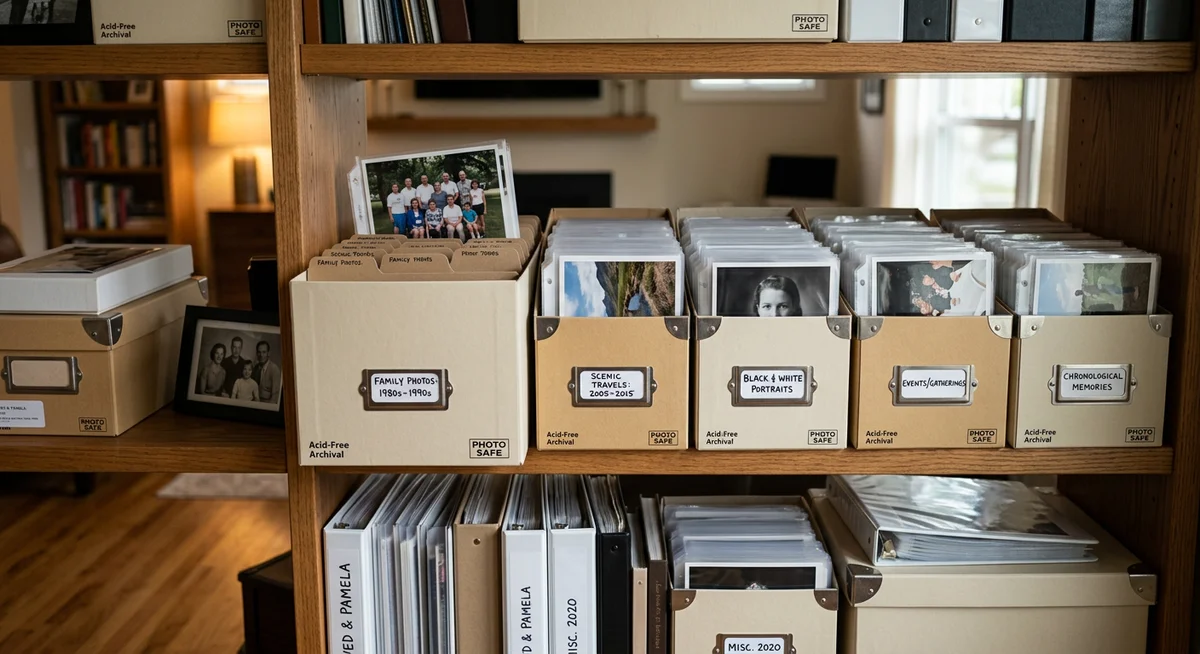
- Store in acid-free folders or sleeves (available at photography and stationery stores). These are labelled as pH-neutral or "archival quality."
- Place those folders inside an acid-free box, not a regular cardboard box. The box should close fully to keep out dust and block light.
- Store the box in an interior room closet, not near exterior walls, attics, or anywhere near kitchen or bathroom humidity.
- Do not use rubber bands, paper clips, or sticky notes on prints - all of these cause physical or chemical damage over time.
- Handle prints from the edges only. Fingerprints leave oils that degrade the surface.
For very high-value or irreplaceable prints, a dehumidifier in the storage room makes a measurable difference during monsoon months. Target 40-50% humidity. A basic hygrometer (under ₹500 at most hardware stores) lets you monitor it.
For photo albums: buy albums labelled acid-free with PVC-free plastic sleeves. Albums with magnetic or "self-adhesive" pages use adhesives that discolour and damage prints over time. They're also difficult to remove photos from later.
How to Protect Prints on Display

Prints on walls face the worst conditions: direct light, temperature swings, and in coastal cities, constant humidity. Here's how to slow down the damage.
UV-filtering glass is the highest-impact upgrade for framed prints. Standard glass blocks some UV, but UV-filtering museum glass blocks up to 99%. The cost difference is modest for a single frame; the impact on a print that's hanging for 10+ years is significant.
Keep prints out of direct sunlight. A print on a wall opposite a west-facing window gets afternoon sun for hours daily. Move it to a wall that doesn't receive direct sun, or use UV-blocking window film if repositioning isn't possible.
Acid-free matting prevents the print from touching the glass (condensation can form on the inner glass surface) and ensures the print doesn't sit against an acidic backing board.
For prints pinned directly to walls or boards - polaroids, strips, anything without glass - there's less you can do beyond keeping them out of direct light. They'll fade faster than framed prints. This is where the type of print matters most.
The India Factor: Why Standard Storage Isn't Always Enough
Standard print preservation advice is written for temperate climates. India presents a different set of conditions: monsoon humidity that can hit 90%, heat that far exceeds recommended storage temperatures for months at a time, and frequent power cuts that interrupt air conditioning.
The reason photo prints fade faster in India comes down to these combined stressors working simultaneously. Managing all of them requires effort and consistent maintenance.
The alternative - and what we'd suggest for any print you're ordering today - is to start with archival-quality prints that don't need special handling. Waterproof photo prints made with pigment-based archival inks are rated to last over 100 years under normal display conditions, including India's climate. They resist humidity because the inks bond at a chemical level that standard dye prints don't. You can hang them, pin them, keep them in a normal album - and they hold colour without any of the storage infrastructure above.
That doesn't mean the storage guidance above is irrelevant - it matters a great deal for old prints, inherited photos, and anything using standard inks. But for new prints, choosing fadeproof archival prints from the start is more reliable than trying to manage the storage conditions afterward.
Frequently Asked Questions
How do you store photo prints long-term at home?
Store prints in acid-free folders or sleeves inside an acid-free box, kept in an interior room closet away from light, heat, and humidity. Avoid regular cardboard, rubber bands, and paper clips. Keep the storage area below 25°C and at 30-50% relative humidity if possible. Handle prints from the edges only.
How do I stop my printed photos from fading?
For stored prints: use acid-free archival materials, keep away from light and humidity, and store in stable temperature conditions. For displayed prints: use UV-filtering glass in frames and keep out of direct sunlight. For new prints: choose waterproof archival prints made with pigment-based inks - they're rated to resist fading for over 100 years without special storage.
Does humidity damage photo prints in India?
Yes, significantly. India's monsoon humidity - regularly 70-90% in coastal cities - accelerates fading, causes warping, and can lead to mould growth on standard prints. The Library of Congress recommends 30-50% relative humidity for photo storage. Archival waterproof prints resist humidity damage because the inks are bonded at a molecular level that standard dye prints are not.
What is the best way to store old photo prints?
Place prints in individual acid-free sleeves or folders, then store in an acid-free archival box in an interior room closet. Keep away from attics, basements, kitchen humidity, and exterior walls. Do not use regular cardboard boxes, magnetic albums, or plastic sleeves that aren't labelled acid-free and PVC-free.
How long do photo prints last if stored properly?
Standard photo prints stored with archival materials in controlled conditions can last 50-75 years before significant degradation. Without proper storage in India's climate, this can drop to 10-20 years or less. Waterproof archival prints using pigment-based inks are rated for 100+ years even under normal display conditions.
Start with Prints Built to Last
Waterproof, fadeproof archival inks - rated for 100+ years. No special storage needed. Delivered across India.
Explore Waterproof Photo Prints