

Waterproof photo prints are physical prints made using UV-resistant pigment-based inks and a water-repellent protective coating. Unlike standard dye-based prints that fade under sunlight and absorb moisture, waterproof photo prints maintain color accuracy and image sharpness for decades - even in humid conditions or rooms with significant light exposure.
That 40-word definition is accurate. But it doesn't explain why it matters, how it works at a practical level, or when you actually need it. So this guide covers all of that - from the chemistry behind the coating to the specific situations where a waterproof print makes a real difference.
This page is part of Memoriffy's complete guide to waterproof and fadeproof photo printing - which covers the full picture if you want the broader context.
What's in This Guide
- What Makes a Photo Print Waterproof?
- Waterproof vs Regular Photo Prints - the Real Difference
- How Long Do Waterproof Photo Prints Last?
- When Do You Actually Need a Waterproof Print?
- What Waterproof Photo Prints Are NOT
- Frequently Asked Questions
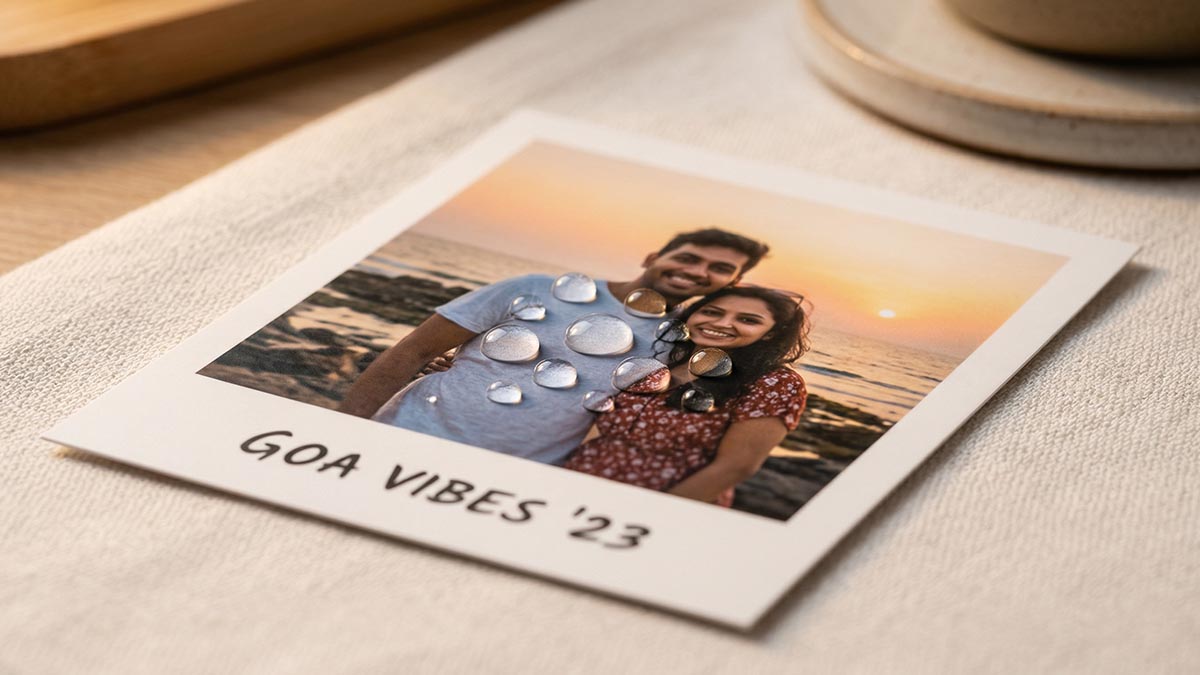
What Makes a Photo Print Waterproof?
A waterproof photo print is made waterproof in two distinct ways - and you need both. One without the other doesn't fully work.
The first is the protective coating. The second is the ink type. Most services that claim "waterproof prints" address one of these. Memoriffy addresses both.
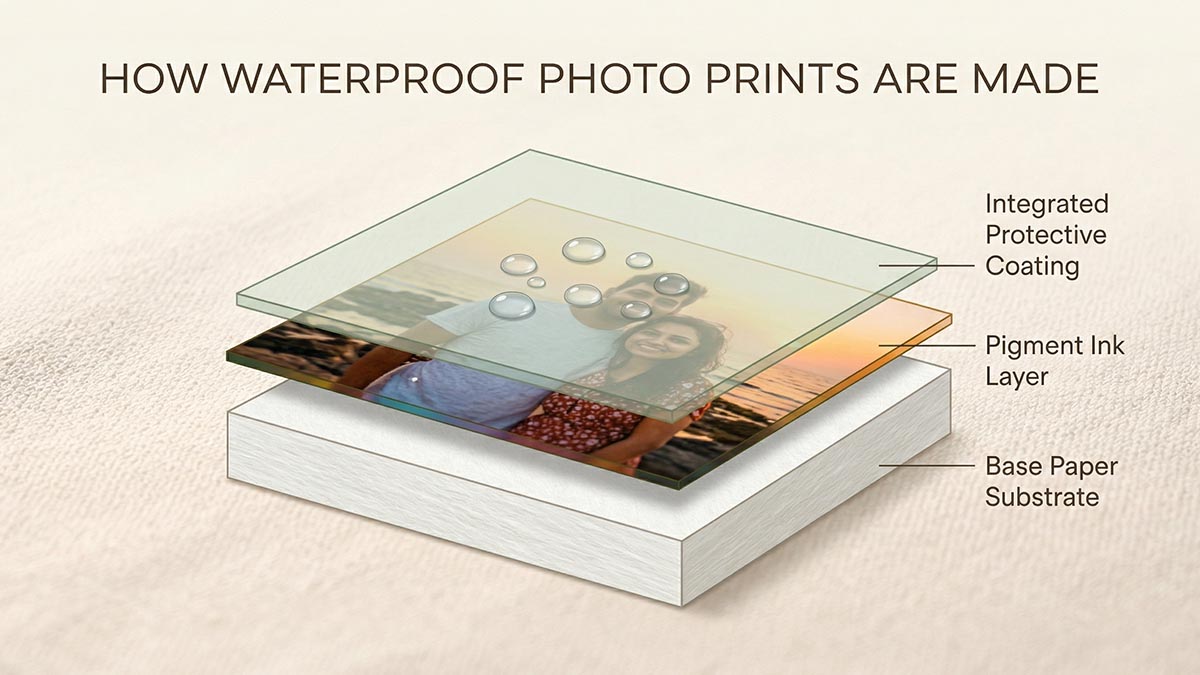
The Protective Coating
The coating on a waterproof print creates a barrier between the print surface and any moisture. It repels water, resists fingerprints, and prevents the paper substrate from absorbing ambient humidity.
Think of it like a Gore-Tex jacket versus a standard cotton shirt. Both keep you clothed. But when rain hits the cotton, it absorbs immediately - the fabric becomes saturated and the garment fails its job. The Gore-Tex repels the water before it gets through. The protection is built into the material itself, not applied as a separate afterthought.
That's the meaningful distinction with print coatings too. Lamination bonds a separate plastic film over the print - you get water resistance, but you also get a plastic feel, edge peeling over time, and a uniformly glossy finish regardless of what you wanted. Memoriffy's waterproof coating is integrated during the print process itself. The surface still feels like a photo.
The Ink Type: Pigment vs Dye
The second component is the ink. Standard photo printing uses dye-based inks. Waterproof photo printing uses pigment-based inks. These aren't just two brands of the same product - they're different materials entirely.
Dye inks work by dissolving color molecules into a liquid carrier. Think of food coloring dropped into water - the color is mixed in, inseparable from the liquid. When UV light hits those dye molecules repeatedly, it breaks their chemical bonds. The color doesn't just fade - it shifts. Blues turn greenish. Reds turn orange. Skin tones go yellow.
Pigment inks work differently. Pigment particles are tiny solid pieces of color suspended in a liquid carrier - more like fine sand in water than dye in water. According to InkjetMall's pigment vs dye ink technical guide, pigment particles maintain their color structure under UV exposure because they're already in a chemically stable solid state - there's nothing for UV radiation to break down the way it breaks down dissolved dye molecules.
Dye fades. Pigment stays. That's the core of it.
The part I find most underrated about this distinction: it's not about print quality on the day you receive it. A dye print and a pigment print can look identical when fresh. The difference shows over time - and that's exactly when it matters most.
As Henry Wilhelm, founder of Wilhelm Imaging Research, notes: "Pigment-based inkjet inks are inherently far more stable under light exposure than dye-based inks. The structural difference between a dissolved dye molecule and a solid pigment particle is the fundamental reason for the dramatic difference in fade resistance."
Waterproof vs Regular Photo Prints - the Real Difference
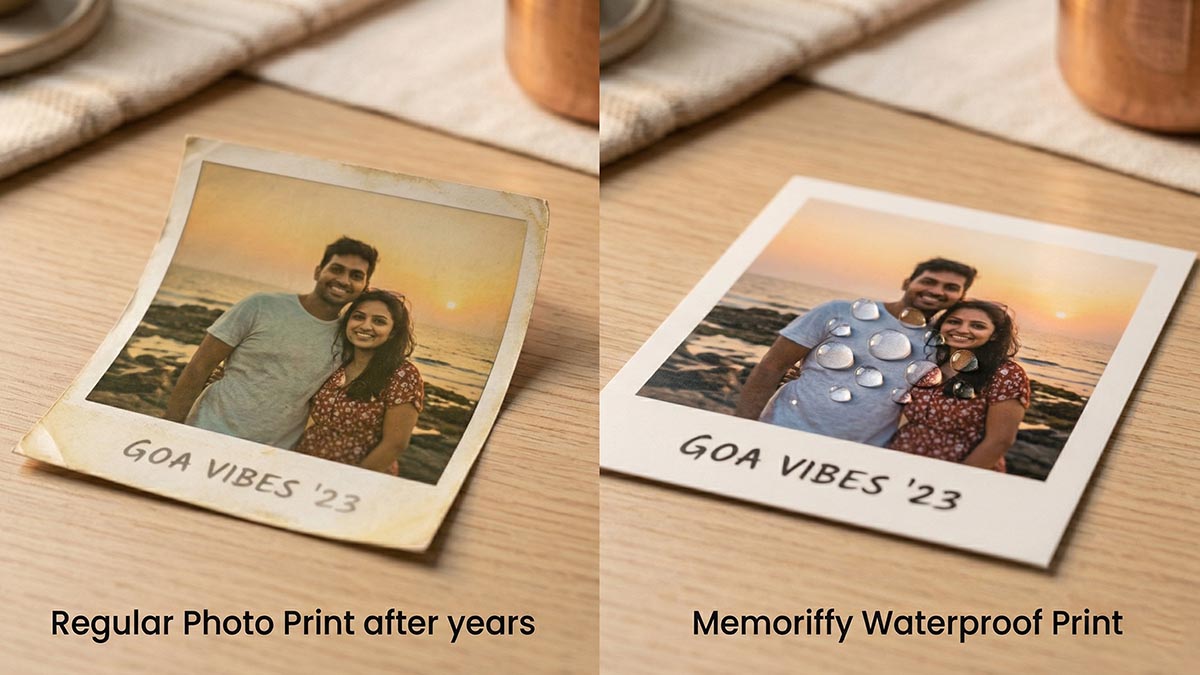
Regular photo prints use dye-based inks on uncoated paper. That combination works fine for the day you pick them up. After that, two things start happening - usually slowly enough that you don't notice until the damage is real.
First, dye molecules break down under light exposure. The speed depends on how much UV hits the print - a south-facing wall in an Indian home gets far more sun than a north-facing flat in London. Second, standard photo paper absorbs ambient moisture from the air. In India during monsoon season, when indoor humidity regularly exceeds 80%, that absorption accelerates degradation considerably.
The practical gap is real. Under normal indoor display conditions, standard dye-based prints show visible color shift within 5-15 years. In India's specific climate - high humidity, high UV - that window shortens. Waterproof photo prints don't have this problem because the coating blocks moisture absorption and pigment inks don't respond to UV the same way dye molecules do.
For a direct side-by-side breakdown across eight criteria - including humidity performance, outdoor suitability, texture, and lifespan - the full waterproof vs regular photo print comparison covers everything with specific examples.
Want to see the difference? Order a single waterproof print - no minimum. Browse all formats →
How Long Do Waterproof Photo Prints Last?
Waterproof photo prints using pigment-based inks maintain color accuracy for 50-100 years under normal indoor display conditions, according to accelerated aging tests by Wilhelm Imaging Research - the US-based organization that independently tests print media longevity and publishes findings as the industry standard for archival printing worldwide.
Standard dye-based prints show visible fading within 5-15 years under the same display conditions. In high-humidity environments, that window is shorter.
"Normal indoor display" means indirect light, indoor temperatures, and typical home humidity. A print on a wall next to a window that gets direct sunlight for six hours a day will fade faster than one in a room with diffused light. Still faster than a dye print, but the conditions matter.
The detailed breakdown of display conditions, storage guidelines, and what actually affects lifespan is in our guide on how long waterproof photo prints last. The short answer: treat them reasonably and they'll outlast every piece of furniture in the room they're hanging in.
When Do You Actually Need a Waterproof Print?
Honest answer: most of the time.
If a photo is worth printing, it's probably worth printing in a format that lasts. But there are some specific situations where waterproof matters more than usual.
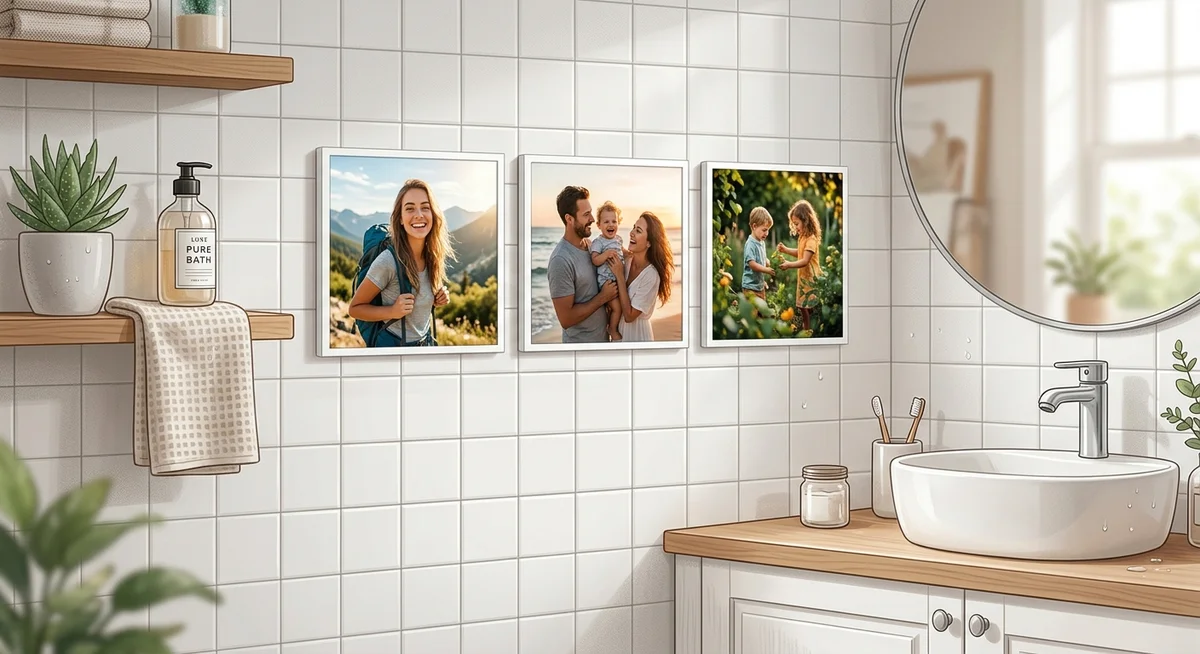
- Bathroom or kitchen display - rooms with high ambient humidity and temperature swings
- Photos near windows that get direct sunlight for several hours daily
- Prints intended as long-term gifts - a photo you give someone should still look right in 15 years
- Room collages with many prints - if one fades faster than the others, the whole wall looks wrong
- Any print in an Indian home during monsoon season - ambient humidity alone is enough to accelerate dye degradation
My honest take: I'd argue the question isn't "when do you need a waterproof print?" It's "when is a non-waterproof print acceptable?" For something you're going to tape to a wall for a week and throw away - fine. For anything you care about actually keeping, the standard print is the wrong choice from the start.
What Waterproof Photo Prints Are NOT
A few things worth clarifying - because there's a lot of loose language around waterproof prints in India's printing market.
Waterproof photo prints are not laminated prints. Lamination bonds a separate plastic sheet to the print surface. That does create water resistance, but the plastic feel is obvious, edges delaminate over time, and the finish is uniformly glossy regardless of what you ordered. A properly made waterproof print has the coating integrated into the print process - no separate layer, no plastic texture.
Waterproof doesn't mean submersible. Hold a Memoriffy print under a tap for 30 seconds and pull it out - the image is fine. Leave it submerged for hours, and eventually moisture will find a way through any coating. Waterproof means it survives what a photo print realistically encounters: spills, humidity, splashes, handling with wet hands. Not swimming pools.
And they don't feel different. The coating isn't a visible layer. A matte waterproof print feels matte. A glossy waterproof print feels glossy. There's no film, no thickness, no texture difference. That's exactly right. According to the Library of Congress preservation guidelines for photographs, the best archival print coatings are those that become indistinguishable from the print surface itself - which is precisely what an integrated coating achieves versus a laminate.
Frequently Asked Questions
Are all photo prints from Memoriffy waterproof?
Every single one - polaroids, square prints, photo strips, timeless prints, calendars, all of them. Waterproof coating and pigment inks are standard across the board. There's no "basic version" without these features. We made a decision early on that this shouldn't be a premium tier. It should be how a photo print is made, period.
Can waterproof photo prints get wet?
Yes. Wipe a spill off the surface, let it dry, and the image is undamaged. They handle rain, splashes, humidity, and bathroom conditions without issue. For sustained submersion over extended periods - not the intended use case, and no print is designed for that. But for everything a photo print realistically encounters in a home, yes.
Are inkjet photo prints waterproof?
Not by default. Standard inkjet printing uses dye-based inks and uncoated paper - that combination is not waterproof. Inkjet printers that use pigment inks can produce waterproof prints, but only if the paper substrate also has a protective coating. The ink type and the coating both matter. Most consumer inkjet prints are neither pigment-based nor coated.
Do waterproof photo prints fade?
Far more slowly than standard prints. Under normal indoor display conditions, pigment-based waterproof prints maintain color accuracy for 50-100 years according to Wilhelm Imaging Research testing data. Standard dye prints under the same conditions show visible fading within 5-15 years. Sustained direct outdoor sunlight will eventually affect any print - but waterproof prints handle it far better and for much longer. The science behind why photo prints fade explains the dye ink degradation process in detail.
What's the difference between waterproof and fadeproof photo prints?
Waterproof addresses moisture resistance - the coating that prevents water from penetrating the print surface. Fadeproof addresses UV resistance - the pigment inks that don't break down under light exposure the way dye inks do. A properly made print should be both. The two properties come from two different parts of the print process and work independently. Memoriffy's prints are both.
Continue Reading
- Waterproof & Fadeproof Photo Prints - The Memoriffy Difference - The full pillar guide covering both properties together: the science, the comparison, and how Memoriffy's process works end to end.
- Why Do Photo Prints Fade? The Science Explained - What happens to dye ink molecules under UV light, and why India's climate makes the degradation happen faster.
- Waterproof vs Regular Photo Prints - Full Comparison - Eight criteria, side by side, with real-world examples for each.