
Most photo prints sold in India are designed to last long enough to seem like a good idea at the time.
Give them three years on a sunlit shelf and the colors drift. Five years and you're squinting at faces that should be vivid. Ten years in, the print has become something between a photograph and a memory of one.
This happens because most photo printing services use dye-based inks on uncoated paper - a combination that looks fine the day it's printed and degrades predictably after that. The chemistry is well-understood. The industry just doesn't talk about it.
Waterproof and fadeproof photo prints are a different category - and it's the defining feature of every custom photo print at Memoriffy. Because the point of printing a photo is for it to still look like a photo in 20 years.
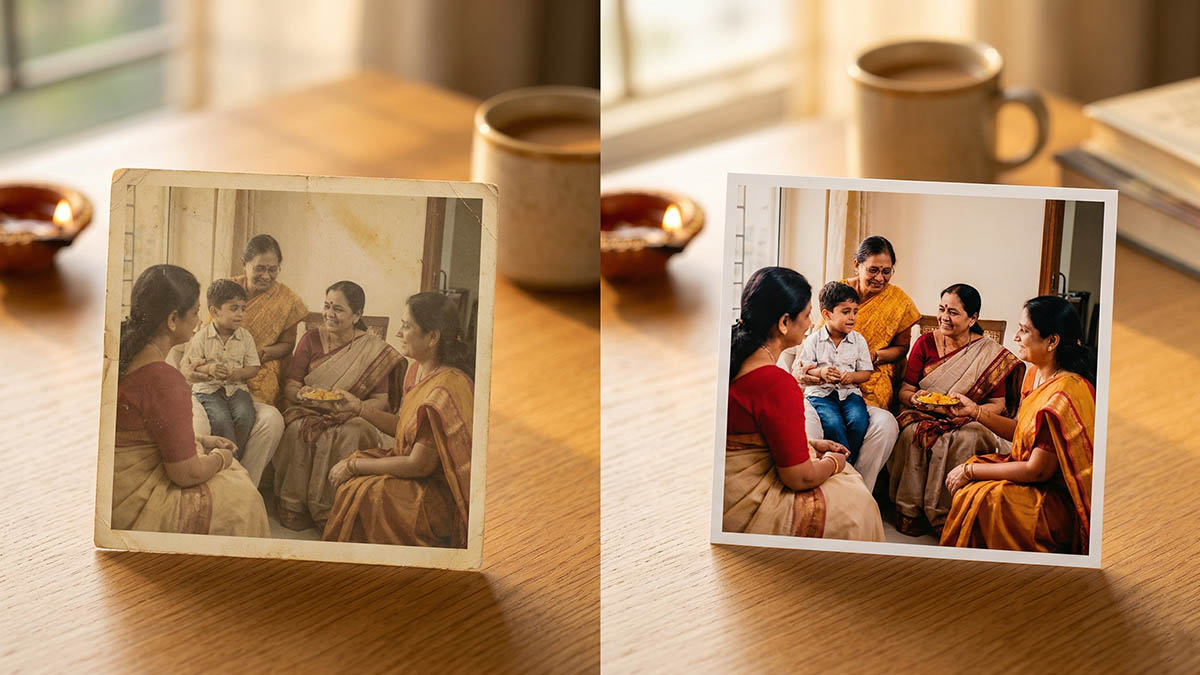
What Are Waterproof & Fadeproof Photo Prints?
Waterproof and fadeproof photo prints are physical prints made using UV-resistant pigment inks and a water-repellent protective coating. Unlike standard dye-based prints that degrade under sunlight and moisture, these prints maintain color accuracy and image sharpness for decades - even in humid conditions or rooms with significant light exposure.
The distinction matters more in India than anywhere else. Humidity levels during monsoon season regularly exceed 80%, and Indian homes face significantly more UV exposure than those in temperate climates. Standard prints degrade faster here. Waterproof and fadeproof prints don't.
Why Regular Photo Prints Fade
Photo fading follows a predictable sequence. Every standard print goes through it.
Dye-based inks work by absorbing light. When UV photons hit dye ink molecules repeatedly - through a window, under a tube light, near a sunny wall - the molecular bonds weaken. The dye fragments into smaller compounds, each reflecting light differently than the original dye. Colors don't just lose saturation. They shift hue. Blues go greenish. Reds go orange. Skin tones turn yellow.
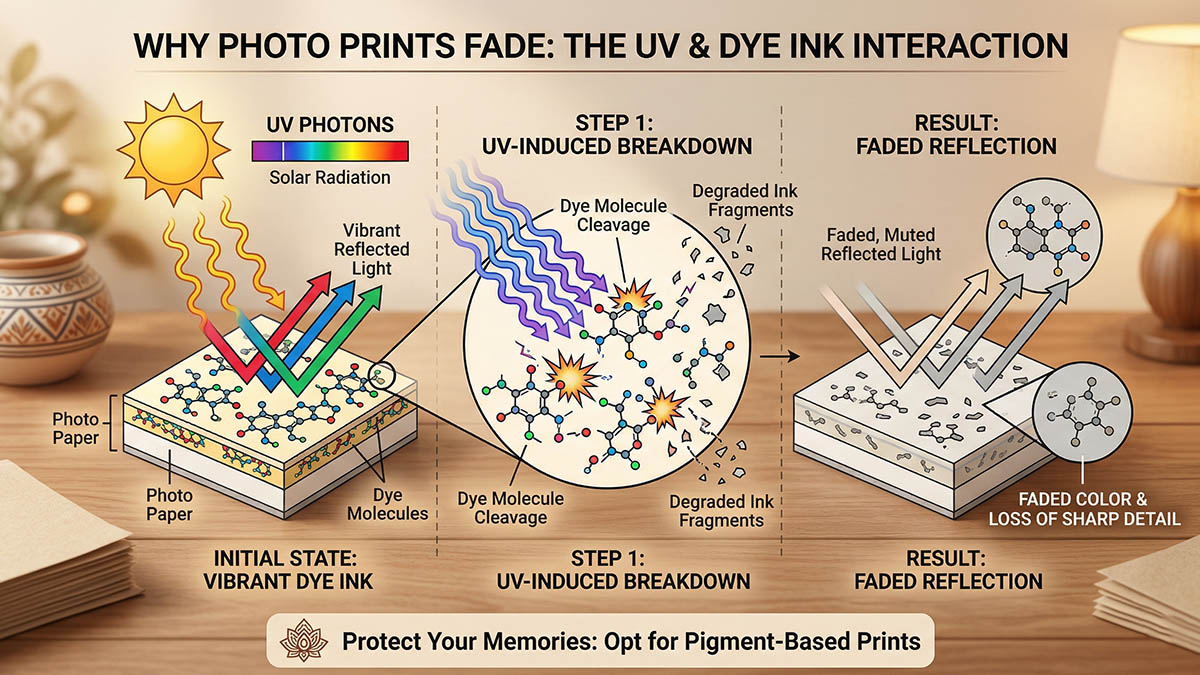
Moisture makes it worse. Standard photo paper is porous - it absorbs humidity from the air and water from direct contact. When dye molecules are both UV-damaged and wet, degradation speeds up. Photos stored in high-humidity environments (India, June through September) fade much faster than those in dry conditions.
Think of it like a paperback novel left out in the rain. The text is still there for a while. But moisture softens the paper, sunlight bleaches the ink, and over time you get a ghost of what was written. Dye ink on standard photo paper works the same way. Pigment ink on a coated substrate is a different material category entirely - more like a hardback with laminated pages.
As Henry Wilhelm, founder of Wilhelm Imaging Research and the world's leading authority on photographic print permanence, writes: "The accelerated permanence testing of inkjet and other digital printing systems reveals differences of 10x or more in the expected display life between the best and worst products available."
What Waterproof Photo Prints Actually Mean
The core mechanism behind waterproof photo prints is a water-resistant coating applied to the surface that prevents moisture from penetrating the print layer. According to the Imaging and Technology standards body, coating technology for photographic permanence addresses three distinct threats:
- Direct water contact - spills, splashes, rain
- High-humidity environments - monsoon conditions, bathroom walls, outdoor display
- Moisture-driven ink bleeding when the paper gets wet
The practical difference is real. Hold a standard print under a tap for 30 seconds and you'll see the paper swell, the surface bubble, and ink begin to migrate. A waterproof print handles the same test without any damage to the image layer.
One thing to be precise about: waterproof doesn't mean you can submerge the print in water indefinitely. It means the image survives moisture exposure that a normal print would not. Wipe it, wash a spill off it, hang it in a bathroom - the print holds.
Memoriffy's waterproof coating is part of the print process, not a plastic laminate applied afterward. The surface still feels like a photo - no plastic feel, no peeling at the edges, no film-over-photo look.
What Fadeproof Photo Prints Actually Mean
Fadeproof - or fade-resistant - photo prints use pigment-based inks instead of dye-based inks. Pigment inks are made from finely ground solid particles suspended in a liquid carrier. Unlike dye molecules, pigment particles don't absorb UV light the same way. They're chemically stable under prolonged light exposure.
The result is a print that holds its original colors far longer than any dye-based alternative.
According to Digital Photography Best Practices (dpbestflow.org), professional archival pigment prints tested under accelerated aging conditions - simulating 8 hours of light exposure per day - show color accuracy lasting 100 years or more. Standard dye prints under the same test conditions show visible color shift within 15-25 years.
That's not a marginal improvement. That's a generational difference in how long your photo looks like your photo.
Fadeproof photo prints are a blue ocean in India - no major printing service markets this property, or even mentions it. Memoriffy is the first Indian photo printing brand to make fadeproof printing a core product commitment, not an optional upgrade.
See the difference yourself. Order a single waterproof, fadeproof print - no minimum order. Browse all formats →
How Long Do Waterproof Photo Prints Last?
Printed and stored correctly, a waterproof and fadeproof print from Memoriffy will maintain its color accuracy for 50-100 years.
"Stored correctly" means away from sustained direct sunlight. A print in a frame on a wall that gets indirect light, or a print kept in an album, will last at the upper end of that range. A print taped to a south-facing window in full sun every day will fade faster - though still far slower than a standard print in the same condition.
Standard dye-based prints on regular photo paper typically show visible fading within 5-15 years with normal indoor display. In India's high-humidity climate, that window shortens.
The longevity data comes from accelerated aging tests by Wilhelm Imaging Research - a US-based organization that independently tests print media longevity and publishes their findings as the industry benchmark. Their research on how long waterproof photo prints last under different display conditions is the most cited reference in archival printing worldwide.
Waterproof vs Regular Photo Prints: A Direct Comparison
Here's how waterproof and fadeproof prints compare to standard prints across the criteria that matter for buyers in India. For real-world examples of each criterion, the full comparison guide goes deeper into each row:
| Criteria | Standard Photo Print | Waterproof & Fadeproof Print |
|---|---|---|
| Ink type | Dye-based | Pigment-based |
| Water resistance | None - paper absorbs moisture | Water-repellent coating on surface |
| UV resistance | Low - dye molecules break down under light | High - pigment particles are UV-stable |
| Expected lifespan (normal indoor display) | 5-15 years before visible fading | 50-100 years of color accuracy |
| Performance in Indian monsoon humidity | Degrades faster - paper absorbs ambient moisture | Unaffected by ambient humidity |
| Suitable for bathroom or humid room display | No | Yes |
| Outdoor display (short-term events) | No | Yes |
| Texture and feel | Standard photo paper | Same feel - coating is integrated, not laminated |
The table tells the story clearly. If the price point is the remaining question, the breakdown of whether waterproof prints are worth the premium goes through the cost-per-year math.
[INFOGRAPHIC: "Waterproof vs Regular Photo Prints - 8-Criteria Comparison" - visual version of the table above with icons for each criterion and clear red/green indicators for standard vs waterproof performance. India-specific callouts for monsoon humidity and UV exposure.]
How Memoriffy Makes It Work
Every custom photo print from Memoriffy - polaroid, square, strip, timeless, or calendar - goes through the same process:
- Your photo is printed using pigment-based inks on premium paper stock, calibrated for accurate color reproduction.
- A water-resistant protective coating is applied during the print process - not as a separate laminate layer added afterward.
- Each print is quality-checked before dispatch. If the color accuracy or sharpness is off, it gets reprinted.
The coating step is what most printing services skip. Standard print shops optimize for speed and volume. At that scale, adding a protective layer costs time and money per unit. The math works against durability.
Memoriffy optimizes for how the print will look in five years. That means slower throughput and a higher per-unit cost. The result is a different product category.

Both matte and glossy finishes are available - and both are waterproof and fadeproof regardless of which you choose. The choice comes down to display environment: the matte vs glossy comparison covers which finish handles direct sunlight, glass reflections, and different photo types better.
Want to test the difference yourself? Order a single print - no minimum quantity. Compare it to anything else you've ordered in India and judge for yourself.
Frequently Asked Questions
Are all Memoriffy prints waterproof and fadeproof?
Every single one. Polaroids, strips, squares, calendars - all of them. Waterproof coating and pigment inks are standard across the board, not a premium tier. We don't make a cheaper version without these features.
What does "fadeproof" actually mean?
Pigment-based inks, which are chemically stable under UV light. Dye inks break their molecular bonds under light exposure and shift colors over time - that's why old photos turn yellow. Pigment particles don't degrade the same way. The print looks the same in 25 years as it does today, under normal display conditions.
Can waterproof photo prints be used outdoors?
Short-term outdoor use - events, weddings, outdoor displays - is fine. For permanent outdoor display, the complete guide to outdoor use covers UV-protective framing options and what to expect over different timescales. The prints handle moisture well; even sustained outdoor UV affects them far more slowly than standard prints.
Do the prints feel different because of the coating?
No - and this is the part people are most surprised by. The coating is applied during printing and doesn't add any noticeable texture. Matte prints feel matte. Glossy prints feel glossy. No plastic film, no laminate layer, no change to how the photo feels in your hand.
How do I prevent my waterproof prints from fading?
Keep them away from sustained direct sunlight - indirect light is fine. Avoid humid rooms like bathrooms for long-term storage. Use UV-protective glass if framing in a bright space. For a complete guide to preventing photo print fading - including display tips and storage advice for all print types - the full guide covers every condition worth knowing about.
How do waterproof photo prints compare to laminated prints?
Laminated prints bond a separate plastic sheet to the print surface. They're water-resistant, but the plastic feel is noticeable, edges can delaminate over time, and the finish looks uniformly glossy regardless of the original print. Memoriffy's waterproof coating is part of the print itself - no separate layer, no plastic feel, no delamination risk.
Are waterproof and fadeproof prints available in all formats at Memoriffy?
Yes. Every format - polaroids, square prints, photo strips, timeless prints, and photo calendars - includes waterproof coating and pigment inks as standard.
Print Once. Keep Forever.
Most photo prints in India will fade before the decade is out. Memoriffy's waterproof and fadeproof prints won't - and they cost less than you'd expect for prints built to last 50-100 years.
Your memories are worth printing on something that lasts.
Browse all waterproof photo print formats at Memoriffy →
Continue Reading
- What Are Waterproof Photo Prints? - The technical breakdown: coating chemistry, what waterproof actually means in practice, and how to test it.
- Why Do Photo Prints Fade? The Science Explained - A deeper look at the dye ink molecular breakdown that turns photos yellow, and why pigment changes everything.
- Fadeproof Photo Prints - Everything You Need to Know - What fadeproof means, how pigment inks differ from dye inks, and the longevity data behind the 50-100 year claim.