

Waterproof & Fadeproof Photo Prints › How Long Do Waterproof Photo Prints Last?
Waterproof photo prints last 50 to 100 years under normal indoor display conditions. Standard dye-based prints show visible fading within 5 to 15 years under the same conditions. In India - where monsoon humidity regularly exceeds 80% and UV exposure is high year-round - standard prints often deteriorate faster than that range suggests.
Those numbers come from accelerated aging tests conducted by Wilhelm Imaging Research, the US-based independent laboratory that sets the global standard for print media longevity testing. But the range is wide for a reason. How long your specific prints last depends heavily on where and how you display them.
This guide breaks down exactly what affects photo print lifespan, what "normal display conditions" actually means in practical terms, and how to get the most years out of every print on your wall.
What's in This Guide
- The Short Answer: 50-100 Years vs 5-15 Years
- What Actually Affects Photo Print Lifespan
- India's Climate and Photo Print Longevity
- Display and Storage Guidelines for Maximum Lifespan
- Lifespan Comparison: Waterproof vs Standard Prints
- Frequently Asked Questions

The Short Answer: 50-100 Years vs 5-15 Years
The difference comes down to two things: ink type and coating.
Waterproof photo prints use pigment-based inks. Pigment particles are solid - tiny flecks of colour suspended in a liquid carrier. Once the carrier evaporates, those particles sit on the paper as stable solids. UV light doesn't break their chemical bonds the way it breaks dye molecules. The colour you see on day one is functionally the same colour in year thirty.
Standard prints use dye-based inks. Dye molecules dissolve into a liquid carrier like food colouring in water. They produce vivid colour initially, but those dissolved molecules are chemically vulnerable. UV light snaps their bonds over time. The colour shifts - reds drift toward orange, blues go green, skin tones yellow out.
The protective coating on waterproof prints adds a second layer of defence. It blocks moisture from reaching the paper substrate. Standard uncoated paper absorbs humidity from the air continuously, which accelerates the chemical degradation of dye inks and warps the paper itself.
Both factors matter independently. A pigment print without coating still resists UV but absorbs moisture. A coated dye print repels water but still fades under light. You need both for the 50-100 year range.
"Our testing consistently shows that the difference in permanence between pigment and dye-based prints under typical indoor display conditions is not a matter of degree - it is an order of magnitude. Pigment prints that test at 100+ years are made with the same underlying technology as what consumers can order today."
- Henry Wilhelm, Wilhelm Imaging Research (via wilhelmresearch.com)
What Actually Affects Photo Print Lifespan
The 50-100 year range is wide because display conditions vary enormously. Here are the four variables that matter most, in order of impact.
1. Light Exposure
This is the single biggest factor. A print on a wall that receives direct sunlight for several hours daily will age faster than one in a room with diffused or artificial light. Even waterproof pigment prints aren't immune to sustained direct UV - they handle it far better than dye prints, but the physics still applies.
Think of it like sunscreen. Factor 50 doesn't mean you can lie in direct sun for 50 hours without consequence. It means you're protected significantly longer than without it. Pigment inks are the Factor 50 of printing - dramatically better protection, but placement still matters.
2. Humidity
Ambient moisture is the second major factor. Standard photo paper is essentially a sponge at the microscopic level - it absorbs water vapour from the air continuously. That moisture interacts with dye molecules and accelerates their breakdown. It also warps the paper over time, causing that familiar curl you see on old prints.
Waterproof prints block this absorption through the protective coating. But even coated prints stored in consistently damp environments - say, a bathroom cabinet with no ventilation - will face challenges over multiple decades.
3. Temperature
Heat accelerates chemical reactions. A print displayed in a room that regularly exceeds 35°C will age faster than one in a climate-controlled space at 22°C. This isn't dramatic - you won't see a difference in five years. But over 30 or 40 years, it compounds.
4. Air Quality
Airborne pollutants - ozone, sulphur dioxide, particulate matter - interact with print surfaces over time. This is a minor factor compared to light and humidity, but in heavily polluted urban environments it's not negligible across decades. The coating on waterproof prints provides some barrier here too, since it sits between the pollutants and the ink layer.
India's Climate and Photo Print Longevity
I'll be direct about this: India is one of the hardest environments in the world for photo print preservation. Not because of any single factor, but because multiple factors stack simultaneously.
During monsoon season, indoor humidity in most Indian homes sits between 70% and 90% - even with windows closed. Most homes don't run dehumidifiers. Standard photo prints absorb that moisture continuously for three to four months. The paper warps. The dye molecules break down faster. By the time the dry season arrives, some of the damage is permanent.
UV exposure is the other half. India sits between 8° and 37° latitude - significantly closer to the equator than Europe or northern North America. Solar UV intensity is higher year-round. A south-facing wall in Mumbai receives more UV in a year than a south-facing wall in London receives in three. Every print on that wall ages proportionally faster.
Add urban air pollution in cities like Delhi, Mumbai, and Kolkata - and all three degradation mechanisms are running at elevated levels simultaneously.
This is exactly why the difference between waterproof and regular photo prints matters more in India than in temperate climates. Standard prints that might last 10-15 years in Scandinavia could show visible fading within 3-7 years in an Indian coastal city. Waterproof prints close that gap far.
The Digital Photography Best Practices guide on print permanence notes that pigment-based inkjet printing is the current standard for archival output specifically because it addresses UV degradation at the ink chemistry level - not just through surface coatings. For Indian conditions, this matters more than in any other major consumer market.
Prints built for India's climate
Every Memoriffy print uses pigment inks with a waterproof coating - tested to maintain colour for 50-100 years even in monsoon conditions.
See Waterproof Prints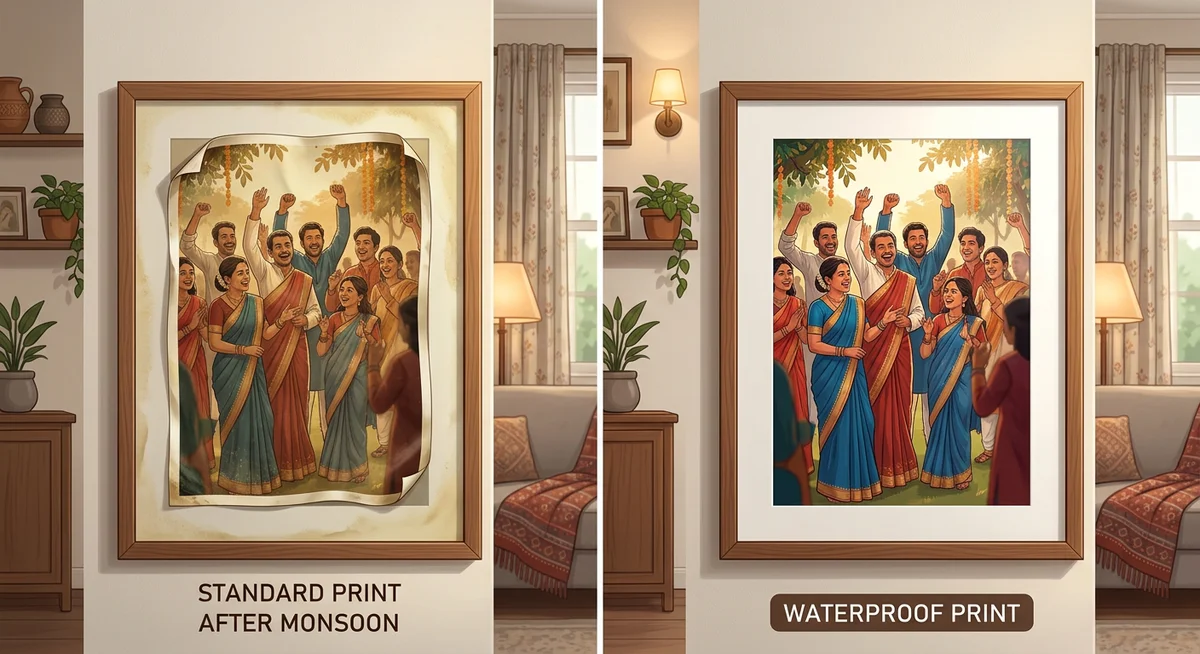
Display and Storage Guidelines for Maximum Lifespan
You don't need museum-grade climate control. A few practical choices make a significant difference.
For Displayed Prints
- Avoid direct sunlight. If a wall gets direct sun for more than two hours daily, choose a different wall - or use a frame with UV-filtering glass. This single choice matters more than everything else combined.
- Keep prints away from heat sources. Not directly above a stove, beside a radiator, or on a wall that backs onto a water heater.
- Ventilate humid rooms. A bathroom print is fine - but a bathroom that stays steamy with the door closed for hours daily is harder on any print. Run the exhaust fan or crack a window.
- Avoid exterior walls in monsoon-prone areas. Exterior walls in older buildings can transfer moisture through to the inside surface. Interior walls are a safer choice for long-term display.
For Stored Prints
For a comprehensive breakdown of India-specific storage conditions, acid-free materials, and how humidity affects different print types, the photo storage and preservation guide covers each factor in detail.
- Store flat, not rolled. Rolling creates a permanent curve over time - even in coated prints.
- Use acid-free envelopes or boxes. Standard cardboard leaches acid onto print surfaces over years. Photo storage boxes from any stationery store are cheap and effective.
- Keep storage dry. A cupboard in a room with AC or a dehumidifier is ideal. Avoid the back of wardrobes on exterior walls - those are humidity traps during monsoon.
- Don't stack prints face-to-face without separators. Over time, surfaces can bond or transfer material. A sheet of butter paper between each print prevents this.
Lifespan Comparison: Waterproof vs Standard Prints
| Condition | Standard Dye Print | Waterproof Pigment Print |
|---|---|---|
| Indoor, diffused light | 10-15 years | 50-100 years |
| Indoor, direct sunlight (2-4 hrs/day) | 3-8 years | 25-50 years |
| High humidity (Indian monsoon, 70-90%) | 3-7 years | 40-80 years |
| Dark storage, controlled climate | 20-30 years | 100+ years |
| Outdoor or semi-outdoor display | 1-3 years | 5-15 years |
Ranges based on accelerated aging test data from Wilhelm Imaging Research. Actual results vary by specific ink formulation, paper substrate, and environmental conditions. The Library of Congress photographic preservation guidelines corroborate these ranges for pigment-based archival prints.
The "outdoor or semi-outdoor" row deserves special attention for Indian homes. Covered balconies, verandas, and shaded garden walls fall in a category of their own - closer to the 5-15 year range than the "1-3 year" fully exposed figure. For a full breakdown of which outdoor scenarios work and which to avoid, see our guide on using waterproof prints outdoors.
Frequently Asked Questions
How long do normal photo prints last?
Normal photo prints last 5-15 years under indoor display conditions. In India's monsoon humidity, that can shorten to 3-7 years.
Standard dye-based photo prints last 5 to 15 years under normal indoor display conditions before visible colour shift appears. In high-humidity environments like Indian homes during monsoon season, that window can shorten to 3-7 years. The exact timeline depends on light exposure, humidity, and temperature - but the fading is inevitable with dye inks because UV light progressively breaks down the dye molecules. The science behind this process is covered in detail in our guide on why photo prints fade.
Do waterproof photo prints last longer than regular prints?
Yes - waterproof prints last 50-100 years versus 5-15 years for standard prints. That's roughly five to ten times longer under identical display conditions.
Significantly longer. Waterproof prints using pigment inks last 50 to 100 years under normal indoor conditions - roughly five to ten times longer than standard dye prints. The difference comes from two things: pigment particles are chemically stable under UV light (dye molecules aren't), and the protective coating prevents moisture absorption that accelerates degradation. Under identical display conditions, the waterproof print will look the same long after the standard print has visibly faded.
Can photo prints last a lifetime?
Yes - pigment-based waterproof prints maintain colour for 50-100 years under normal indoor display. That covers a full human lifetime in most scenarios.
With the right ink and coating, yes. Pigment-based waterproof prints maintain colour accuracy for 50-100 years under normal indoor display. That covers a full human lifetime for most display scenarios. The prints you put up in a nursery when your child is born can still be vivid when that child has children of their own. The key is using pigment inks (not dye), having a protective coating (not lamination), and displaying them away from sustained direct sunlight.
How should I store photo prints to make them last longer?
Store prints flat in acid-free boxes, away from direct sunlight and moisture. Avoid exterior-wall cupboards in monsoon-prone areas. Use butter paper between stacked prints.
Store prints flat - never rolled - in acid-free envelopes or photo storage boxes. Keep them in a dry space, ideally in a room with air conditioning or a dehumidifier. Avoid exterior-wall cupboards in monsoon-prone areas, since those walls transfer moisture inward. Place a sheet of butter paper between stacked prints to prevent surface bonding. For displayed prints, the single most impactful choice is avoiding walls that get direct sunlight for more than two hours daily.
Do Memoriffy prints fade?
No - not under normal indoor conditions. All Memoriffy prints use pigment inks with a waterproof coating rated at 50-100 year colour accuracy in independent testing.
All Memoriffy prints use pigment-based inks with an integrated waterproof coating - the same combination that achieves 50-100 year colour accuracy in independent testing. Under normal indoor display conditions, you won't see visible fading in your lifetime. Direct outdoor sunlight over many years will eventually affect any print, but Memoriffy's fadeproof printing process is built specifically to resist both UV degradation and moisture damage simultaneously.
Continue Reading
- Can Waterproof Photo Prints Be Used Outdoors? - Scenario-by-scenario verdict for balconies, shaded walls, events, and fully exposed outdoor display in Indian conditions.
- Waterproof & Fadeproof Photo Prints - The Memoriffy Difference - The full pillar guide covering both waterproof and fadeproof properties: the science, the process, and what makes it different.
- Why Do Photo Prints Fade? The Science Explained - The chemistry behind dye ink degradation and why India's climate accelerates the process.
- What Are Waterproof Photo Prints? - How pigment inks and protective coatings work together to create a print that resists both moisture and UV.