

Fadeproof photo prints are prints made using UV-resistant pigment-based inks that maintain color accuracy for decades - not years. Unlike standard dye-based prints, which begin losing color the moment light hits them, fadeproof prints use solid pigment particles that hold their chemical structure under prolonged UV exposure. The color you see on day one is the color you see in year twenty-five.
That definition tells you what they are. It doesn't tell you why most photo prints fade, how this one doesn't, or when the difference actually matters. This guide covers all of that.
This page is part of Memoriffy's complete guide to waterproof and fadeproof photo printing - which covers both properties together if you want the full picture first.
What's in This Guide
- What Makes a Photo Print Fadeproof?
- Fadeproof vs Waterproof - Are They the Same Thing?
- How Long Do Fadeproof Prints Actually Last?
- What Causes Standard Prints to Fade?
- When Does Fadeproof Actually Matter?
- What Fadeproof Photo Prints Are NOT
- Frequently Asked Questions

What Makes a Photo Print Fadeproof?
The answer is entirely in the ink. Specifically, whether the color in the print is made from dye molecules or pigment particles - because these two materials respond to UV light in completely different ways.
Pigment Inks: Why They Don't Fade
Pigment inks use tiny solid particles of color suspended in a liquid carrier. Think of it like sand in water: the particles are distinct, physical objects - not dissolved into the liquid, just suspended in it. Pour out the water and the sand remains exactly as it was. Apply UV light to those particles repeatedly, and their chemical structure holds because they're already in a stable solid state. There's nothing for UV radiation to break down the way it breaks down dissolved molecules.
This is why pigment-based prints are classified as archival. According to the Library of Congress digital preservation standards, archival-grade prints require inks with demonstrated stability under accelerated aging conditions - a standard pigment inks meet and dye inks don't. The pigment particle you see on day one is the same pigment particle ten years later. It hasn't shifted, degraded, or reacted with anything.
As Henry Wilhelm, founder of Wilhelm Imaging Research and the world's foremost authority on photographic print permanence, writes: "Pigmented inkjet inks have dramatically longer display permanence than dye-based inks under all light sources tested. The difference in expected display life between the best pigment products and the average dye-based product can exceed a factor of ten."
The Part People Most Often Get Wrong
The part people most often get wrong about fadeproof prints: the difference is invisible on day one. A pigment print and a dye print placed side by side when fresh look identical. You cannot tell them apart by looking. You can only tell them apart by waiting - and by the time the difference is visible in the dye print, the damage is already done and not reversible.
This is why the ink type matters more than it appears to. You're not buying a better-looking print today. You're buying a print that still looks right fifteen years from now.
Fadeproof vs Waterproof - Are They the Same Thing?
No - and this is the confusion worth clearing up directly.
Fadeproof addresses UV resistance. It's about whether the ink in the print holds its color when exposed to light over time. The mechanism is the ink type - pigment particles versus dye molecules.
Waterproof addresses moisture resistance. It's about whether the print surface repels water and prevents the paper substrate from absorbing ambient humidity. The mechanism is the protective coating applied during or after the print process.
These are two separate properties that come from two separate parts of the print process. You can have one without the other. A print can use pigment inks (fadeproof) on uncoated paper (not waterproof) - meaning it'll hold its color under light but warp and absorb moisture in a humid room. Or it can use a water-resistant coating on dye inks - meaning it resists spills but still fades under sunlight.
A properly made print - like the waterproof photo prints Memoriffy makes - addresses both. Pigment inks for UV resistance, integrated coating for moisture resistance. The two work independently and you need both for a print that genuinely lasts.
Ready to order a fadeproof print? Every Memoriffy print uses pigment inks as standard - no premium tier, no extra charge. Browse all formats →
How Long Do Fadeproof Prints Actually Last?
Under normal indoor display conditions - indirect light, indoor temperatures, typical home humidity - pigment-based fadeproof prints maintain color accuracy for 50-100 years, according to accelerated aging tests by Wilhelm Imaging Research. Wilhelm is the US-based organization that independently tests print media longevity and publishes findings as the industry standard for archival printing worldwide.
Standard dye-based prints show visible color shift within 5-15 years under the same conditions. In India specifically, where indoor humidity during monsoon season regularly exceeds 80% and UV exposure from south-facing windows is higher than most Northern Hemisphere baselines, dye print degradation accelerates further. That 5-15 year window shortens.
The honest note: "normal indoor display" matters. A print next to a window that gets direct sunlight for six hours a day will degrade faster than one in a room with diffused ambient light. Still much slower than a dye print - but the display environment is a real variable. The detailed breakdown of how display conditions affect lifespan is in the guide on how long fadeproof photo prints last, including specific numbers for different placement scenarios.
What Causes Standard Prints to Fade?
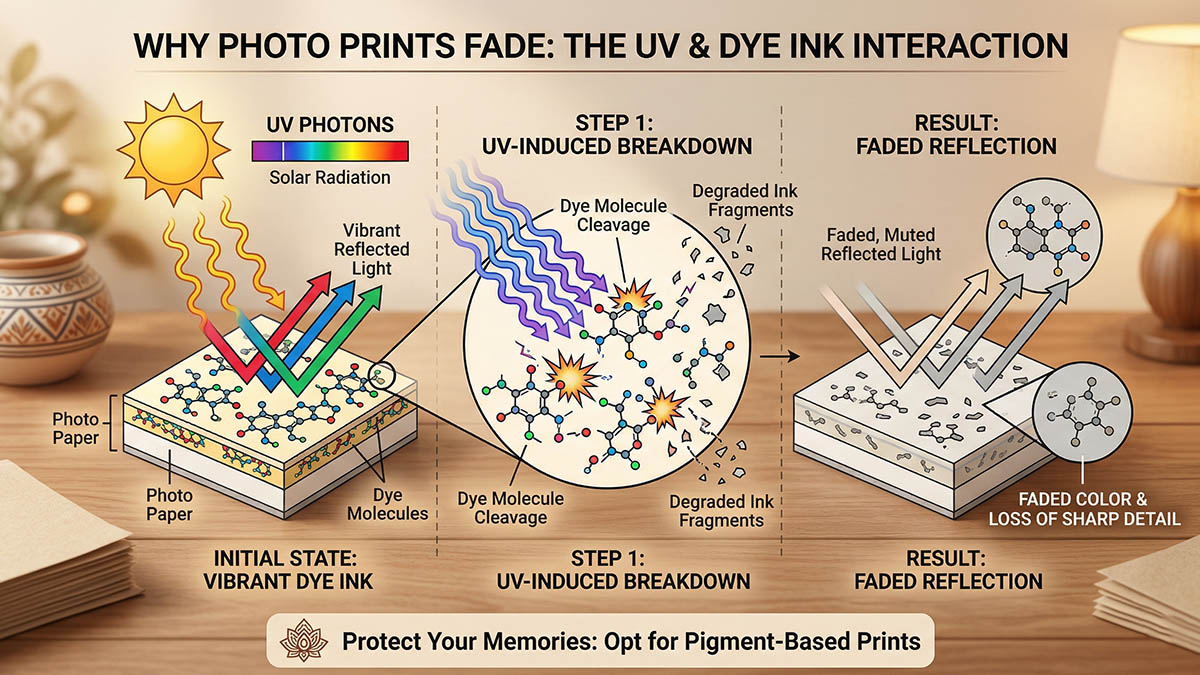
Standard photo printing uses dye-based inks. Dye inks work by dissolving color molecules into a liquid carrier - the color isn't a solid particle, it's fully integrated into the liquid, the way food coloring integrates into water. You can't separate them after the fact.
When UV light hits those dissolved dye molecules repeatedly, it breaks their chemical bonds. And it doesn't break all colors equally - different dye molecules have different UV sensitivity. Cyan dyes tend to break down faster than magenta, and both faster than yellow. So a print doesn't just fade uniformly - it shifts. Blues go greenish. Reds go orange. Skin tones go yellow. The image you printed isn't just dimmer; it's a different image.
The full chemistry behind this - including why India's specific climate combination of high UV and high humidity creates a worse degradation environment than most other markets - is covered in detail in the guide to why photo prints fade.
When Does Fadeproof Actually Matter?
Honest answer: whenever the print is meant to last.
But some situations where it matters more than usual:
- Photos displayed near windows - even indirect sunlight exposure compounds over years
- Prints in south-facing rooms in Indian homes - higher UV index than most people account for
- Long-term gifts - a photo you give someone should still look right when they look at it in 2035
- Wall collages with multiple prints - if two prints age at different rates, the whole arrangement looks wrong
- Any print you actually care about - the question isn't whether it matters, it's whether the photo matters
I'd argue the real question isn't "when do I need a fadeproof print?" It's "when is a non-fadeproof print acceptable?" The answer to that is narrow: anything you're printing to use once and throw away. For anything you're framing, gifting, or keeping, dye ink is the wrong material from the start - and you won't know it until the damage has already happened. Once you have a fadeproof print, our guide on preventing photo print fading covers the display habits that extend lifespan even further.

What Fadeproof Photo Prints Are NOT
A few clarifications - because there's a lot of loose language used by printing services in India around this term.
Fadeproof does not mean immune to all fading under all conditions forever. Sustained direct outdoor exposure in full sunlight will eventually affect any print. Fadeproof means fade-resistant to a degree that makes indoor display a solved problem for decades, not years. The pigment ink chemistry is stable - but there are physical limits to every material.
Fadeproof is not the same as water-resistant. These are independent properties and a "fadeproof" label from a printing service tells you nothing about moisture resistance unless they specify the ink type and the coating separately. Ask both questions if you're comparing services.
And fadeproof doesn't require a visible difference in appearance. A fadeproof print using pigment inks looks identical to a dye print on day one. The difference is structural, not visual - it's in the chemistry of what's in the ink, not in anything you can see or feel. This is also why the comparison between fadeproof and standard prints needs to be looked at across a time dimension, not just at the point of delivery.
Frequently Asked Questions
Are all Memoriffy prints fadeproof?
Yes - every print uses pigment-based inks as standard. There is no dye-ink version, no basic tier, no option that doesn't include it. The decision to use pigment inks wasn't a premium feature decision - it was a quality floor decision. Every format (polaroids, square prints, photo strips, timeless prints, calendars) uses the same ink system.
What's the difference between fadeproof and archival photo prints?
Archival is the broader term used in professional printing contexts - it refers to prints designed to meet long-term preservation standards, typically using pigment inks and acid-free media. Fadeproof is the consumer-facing description of the same core property: the print resists UV-induced color degradation over time. A print marketed as "fadeproof" that uses pigment inks and has been tested for longevity is functionally archival. The terminology differs by context, not by the underlying chemistry.
Do fadeproof photo prints look different from regular prints?
Not on day one - and that's the point. A pigment print and a dye print look identical when fresh. The difference shows up over years of display. This is exactly why print quality at delivery isn't a useful comparison point. The metric that matters is what the print looks like in year ten. On that measure, the difference is real.
Can I get fadeproof prints in matte finish?
Yes. The ink type (pigment vs dye) and the finish (matte vs glossy) are independent choices. Fadeproof pigment inks work with both finishes. A matte fadeproof print feels and looks matte - the protective coating doesn't create a glossy layer over it. The finish you choose is the finish you get.
Do fadeproof prints cost more?
At Memoriffy, no - pigment inks are standard across all prints at no premium. In the broader market, pigment ink printing can carry a higher per-print cost than dye printing because the ink costs more to produce and the printers require higher-precision equipment. Whether that premium is worth it depends on whether the photo is worth keeping - and if it is, yes.
Continue Reading
- Why Waterproof Prints Beat Regular Prints - A direct side-by-side comparison with cost-per-year data that makes the case for upgrading beyond dye inkjet.
- Waterproof & Fadeproof Photo Prints - The Memoriffy Difference - The full pillar guide covering both properties together: the science, the comparison, and how Memoriffy's process works end to end.
- Why Do Photo Prints Fade? The Science Explained - The complete breakdown of UV-induced dye degradation, including why India's climate makes it happen faster.
- What Are Waterproof Photo Prints? - The companion entity anchor page covering moisture resistance, the protective coating, and how waterproof and fadeproof work together.