

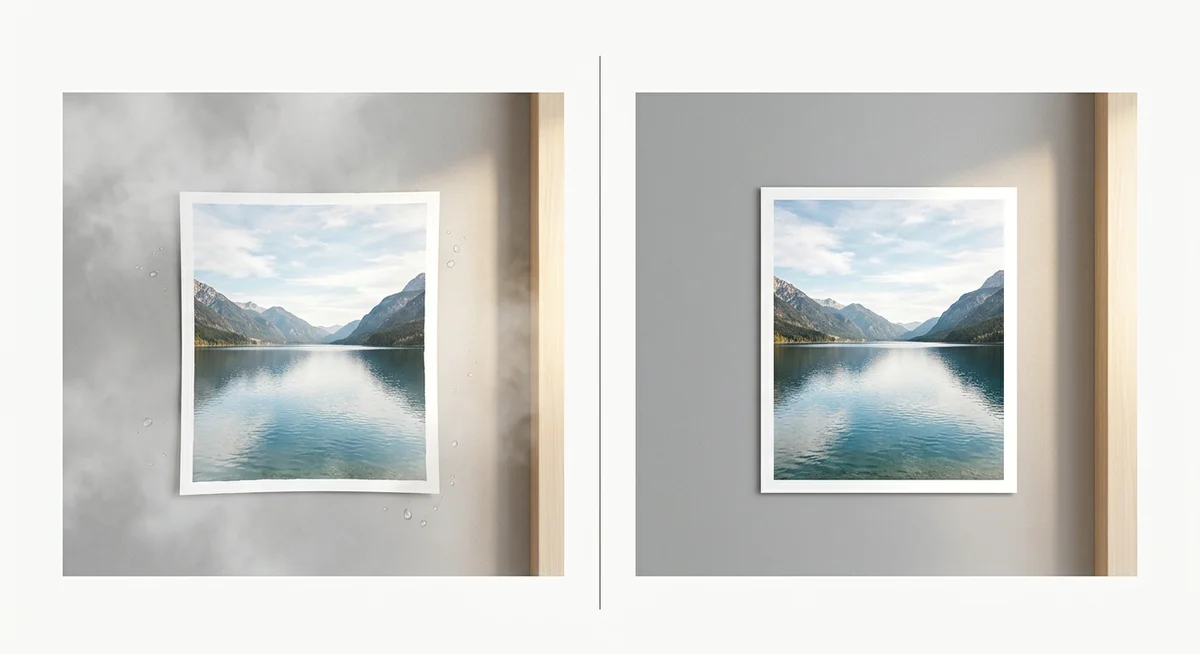
Put a waterproof photo print and a regular photo print side by side on the day they're made. You cannot tell them apart. Same colors, same finish, same weight. The question is what happens between day one and year ten.
The core difference is in the ink system and the surface treatment. Regular prints use dye-based inks on uncoated paper - vulnerable to UV light and humidity. Waterproof prints use pigment-based inks with an integrated protective coating that resists both, maintaining color accuracy for decades rather than years.
This page is part of Memoriffy's complete guide to waterproof and fadeproof photo printing. That guide covers the full science end to end. This article focuses specifically on the comparison: where the two print types differ, where they don't, and which situations make the difference meaningful.
What's in This Guide
- The Quick Verdict
- What Makes a Photo Print "Regular"?
- What Makes a Photo Print Waterproof?
- Side-by-Side Comparison
- The Criteria That Actually Matter
- When Does the Difference Matter?
- Frequently Asked Questions
The Quick Verdict
If the print is meant to last - on a wall, in a frame, as a gift - choose a waterproof print using pigment inks. If it's printed to use once and discard, the difference won't matter in practice.
For anything you intend to keep, dye ink on uncoated paper starts failing from the day it's exposed to light. No amount of after-the-fact lamination changes what the ink itself can't hold. Same print. Different chemistry. Different future.
What Makes a Photo Print "Regular"?
A regular photo print uses dye-based inks. Dye inks work by dissolving color molecules into a liquid carrier - the molecules fully integrate into the paper substrate. Think of food coloring dissolved in water: the color isn't sitting on top of the liquid, it's part of it.
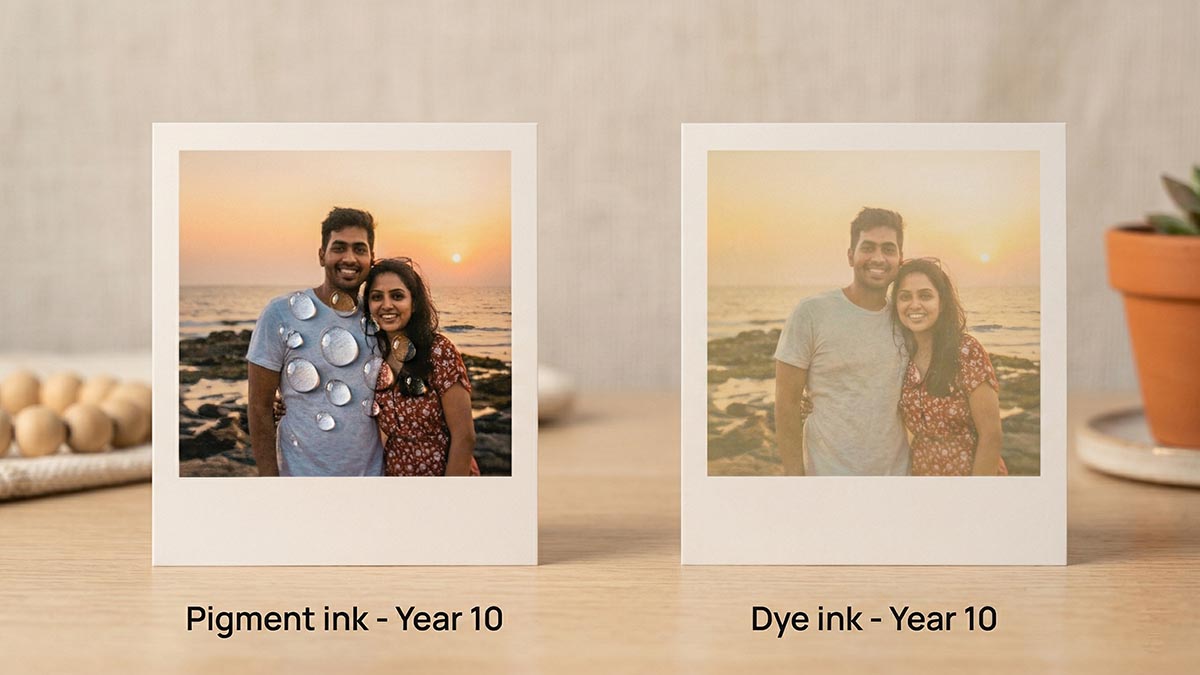
The problem is that dissolved dye molecules are chemically unstable under sustained UV exposure. Light breaks the molecular bonds - and it doesn't break them evenly across colors. Cyan dyes degrade faster than magenta and yellow. So a regular print doesn't fade uniformly. It shifts. Reds move toward orange. Blues turn greenish. Skin tones go yellow. By year five or six, the image has changed in ways that can't be reversed.
Water compounds this. Paper absorbs moisture, and when it does, the dye molecules dissolved into it move - creating tide marks, blotches, and surface warping. Humidity alone, not even a direct spill, causes this over months in Indian homes during monsoon season. The detailed chemistry behind all of it is in the guide to why photo prints fade.
What Makes a Photo Print Waterproof?
Two changes to the same print process create the waterproof result: the ink type and the surface coating.
Instead of dissolved dye molecules, waterproof photo prints use pigment inks - solid color particles suspended in a carrier liquid. The particles don't dissolve into the carrier; they're held in suspension. Apply UV light to those particles repeatedly and their chemical structure holds, because solid particles don't break down the way dissolved molecules do. The color is stable because the ink is physically stable.
The second change is the surface coating applied during the print process - a protective layer that seals the print surface against moisture infiltration. It repels water on contact and significantly reduces the paper substrate's ability to absorb ambient humidity. The coating works on the surface; the pigment inks work at the ink level. Together they address both failure modes that eventually destroy regular prints.
My honest read on why this distinction matters: most people asking about waterproofing think about spills. That's the visible risk. The invisible risk - UV-induced color shift over years - does more total damage to more prints. The ink choice protects against the risk you're less likely to notice until it's too late.
As Henry Wilhelm, founder of Wilhelm Imaging Research, states: "The expected display permanence of a photographic print is determined primarily by its ink system. Pigment-based systems are categorically more stable than dye-based systems under light exposure - the difference is not incremental, it is fundamental."
All Memoriffy prints are waterproof and fadeproof - at no extra charge. Browse all formats →
Side-by-Side Comparison
| Criterion | Regular Photo Print | Waterproof Photo Print |
|---|---|---|
| Ink type | Dye-based (dissolved molecules) | Pigment-based (suspended particles) |
| UV resistance | Low - color shift within 5-15 years | High - pigment particles stable under UV |
| Moisture resistance | None - paper absorbs humidity | Integrated coating repels water and humidity |
| Lifespan (indoors) | 5-15 years before visible fading | 50-100 years (Wilhelm Imaging Research data) |
| India climate suitability | Poor - monsoon humidity + high UV accelerate degradation | Designed for high humidity and UV environments |
| Appearance at delivery | Identical to waterproof print | Identical to regular print |
| Finish options | Matte or glossy | Matte or glossy |
| Price | Lower (dye ink costs less) | Slight premium (pigment ink production cost) |
The row that surprises most people: appearance at delivery. Both print types come out looking identical. The difference is invisible on day one and only becomes visible over time - which means you can't make the comparison at the point of purchase. You can only make it by knowing what ink system produced the print.
The Criteria That Actually Matter
Longevity
Regular prints: 5-15 years under normal indoor display conditions before visible color shift occurs. That assumes temperate conditions - moderate humidity, indirect light exposure.
Waterproof prints: 50-100 years according to accelerated aging tests by Wilhelm Imaging Research, the US-based organization whose longevity testing is the industry standard for archival printing worldwide. The full breakdown by display condition - diffused light versus south-facing windows versus direct sunlight - is in the guide on how long waterproof photo prints last.
In India, the gap widens. Monsoon season regularly brings indoor humidity above 80%, and UV index in south-facing rooms runs higher than the conditions used in standard longevity testing. The 5-15 year estimate for regular prints was measured under better conditions than most Indian homes provide.
Fade Resistance
The distinction here is not "slower fading" versus "faster fading." It's a different failure mode entirely. Dye prints degrade through molecular breakdown under UV - a chemical process that's irreversible and cumulative. Fadeproof photo prints using pigment inks don't experience the same process at all, because the pigment particles don't have dissolved molecular bonds to break.
This is the difference between a process that slows down degradation versus one that removes the primary mechanism of degradation. It's not the same category of result.
Moisture and Humidity
Think of a cotton shirt left damp in a bag versus a technical quick-dry fabric. Both start looking fine. The cotton absorbs the moisture and holds it - warping, mold, stiffness follow. The quick-dry fabric sheds the moisture and returns to its original state. Regular photo paper behaves like the cotton. Waterproof photo paper with an integrated coating behaves like the technical fabric - the surface doesn't get the chance to absorb what's hitting it.
For display in Indian homes during monsoon season, this property is the difference between a print that survives the summer intact and one that starts to show tide-mark damage along the edges by October.
Appearance on Day One
Identical. Worth repeating because it's the part people most frequently underestimate. You cannot use visual inspection at delivery to tell a waterproof print from a regular one. The difference is structural, not visual - it lives in the ink chemistry, not in the surface appearance.
This means the comparison only becomes observable by waiting. For the people who notice their photos fading after a few years and assume "that's just what photos do" - it's not. It's what that specific ink type does.

When Does the Difference Actually Matter?
The difference matters any time the print is meant to outlast the occasion.
- Wall prints that see light - even indirect window light compounds UV exposure over years
- Photo gifts - a print given in 2026 should still look right when the recipient looks at it in 2036. Our photo gift ideas guide covers formats that pair well with waterproof printing
- Monsoon-season display - high indoor humidity June through September is enough to damage regular prints on walls in India
- Large format prints - a mounted wall print represents real cost; replacing it in five years doubles that cost
- Milestone photos - weddings, newborns, graduation portraits can't be re-shot if the print degrades
There's a narrower case for regular prints: things you print to use once or for very short-term display. Reference prints for photo editing. Single-use prints for an event backdrop. Anything where longevity isn't the point. For anything else, the ink choice matters from the start and can't be fixed retroactively.
Frequently Asked Questions
Can I make a regular photo print waterproof after printing?
You can add laminate film or a spray-on UV coating to a regular print after the fact. These create some surface moisture resistance. They don't change what's underneath - the dye ink molecules are already dissolved into the paper and will still break down under UV exposure over time. A laminate covers the surface; it doesn't change the ink chemistry. You're solving one failure mode while leaving the other untouched.
Do waterproof photo prints feel different from regular prints?
No - and that's by design. The integrated coating is applied to maintain the same feel and finish as an uncoated print. You won't feel the coating as a separate layer, and it doesn't alter the surface texture you chose (matte stays matte, glossy stays glossy). The protection is in the chemistry, not in a detectable physical layer.
Are all digital photo prints the same quality at delivery?
At delivery, yes - if the printer is calibrated correctly, a dye print and a pigment print of the same image will look identical. Delivery quality and long-term stability are separate variables. A well-calibrated dye print can look better on day one than a poorly managed pigment print, and still fade faster over the following decade. The ink type determines the trajectory, not the starting point.
Is waterproof the same as outdoor-safe?
Not automatically. Waterproof photo prints resist moisture and UV exposure well enough for any indoor environment and covered outdoor spaces. For fully exposed outdoor display - direct rain, full sunlight for hours daily - the requirements are more demanding than most paper-based prints can meet regardless of coating. For indoor display in India's climate, including during monsoon season, waterproof prints are the right choice. For direct outdoor exposure, our guide on using waterproof prints outdoors breaks down which scenarios work and which to avoid.
Why do most photo printing services in India still use dye inks?
Cost. Dye ink printing is cheaper to run at scale - the ink costs less to produce and the equipment is less expensive. Pigment ink printing requires higher-precision printers and more expensive ink. For a service competing purely on low per-print price, dye ink is the obvious choice. The customer absorbs the cost later, in the form of prints that fade within a decade rather than lasting fifty years.
Continue Reading
- Why Waterproof Prints Beat Regular Prints - The same comparison taken further: cost-per-year breakdown, India climate data, and all 9 criteria scored head-to-head.
- Waterproof & Fadeproof Photo Prints - The Memoriffy Difference - The full pillar guide: the science behind both properties, how the print process works, and why India's climate makes these properties more relevant here than most markets.
- What Are Waterproof Photo Prints? - The entity anchor page covering the technical definition, how the coating works, and the pigment ink system in detail.
- How Long Do Waterproof Photo Prints Last? - Longevity numbers by display condition, with Wilhelm Imaging Research data and specific guidance for Indian climate display environments.