

- A travel photo book works best when photos are organised by trip - not dumped chronologically by date - so each journey gets its own visual story
- Most Indian travelers shoot 800-2,000 photos per trip on smartphones; good travel books use 60-100 selects per trip, not the full camera roll
- Travel books get handled far more than wedding albums - backpack humidity, tropical climate, and repeated viewing all stress the paper and binding
- Archival pigment printing resists fading significantly longer than standard photo paper; for travel books that survive years of handling, it's the right choice
- Smaller formats (8x8 square or 5x7) work better for travel books than large landscape formats - they're portable, stack easily, and feel personal rather than ceremonial
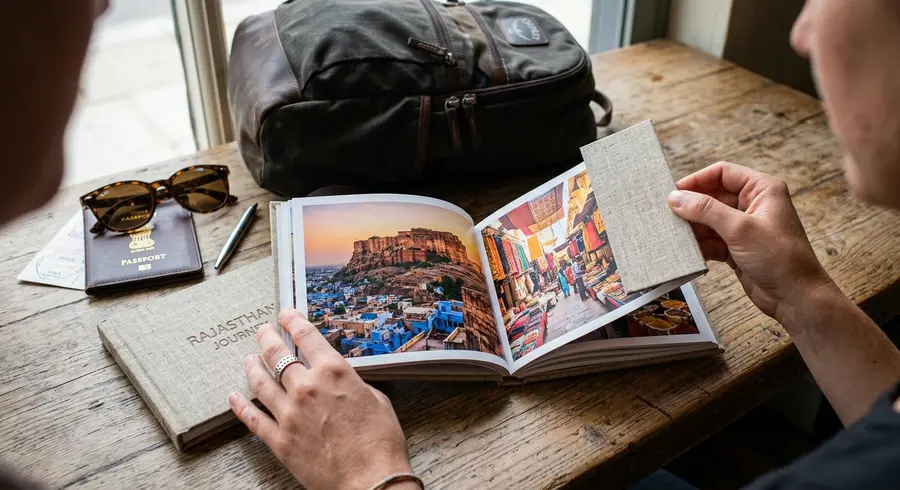
Picture this: you're back from 10 days in Rajasthan. Jaipur, Jodhpur, Udaipur. You have 3,200 photos on your phone. Every pink wall, every camel, every rooftop sunset over a lake palace. You showed them to your family on a 5-inch screen at dinner, zooming in and out while everyone squinted. Three weeks later, nobody has looked at them again.
Those photos are sitting in Google Photos, sorted by date, increasingly hard to find. They'll stay there, probably forever.
That's the story for most Indian travelers. Not from lack of interest in the trip - from lack of a format that makes the photos worth returning to. A well-made travel photo book changes that. It forces you to make choices, cut the clutter, and present a trip as a story rather than a dump. And when it's done right, it becomes the thing you pull out every time someone asks about that holiday.
This guide covers how to make a travel photo book in India - from organising your phone camera roll to choosing the right size, paper quality, and printing option that actually holds up over time.
What Makes a Good Travel Photo Book?
Voice search answer: The best travel photo book for India trips organises photos by journey rather than by date, uses fade-resistant archival paper, and comes in a portable size between 5x7 and 8x10 inches.
A travel photo book is different from a wedding album in almost every way that matters for design and durability. Wedding albums live on a shelf and come out at anniversaries. Travel photo books get thrown in a bag, carried to a relative's house, and picked up by kids with hands of questionable cleanliness.
The best travel photo book for Indian travelers has five qualities:
- Portable size - something you can carry without a second thought, not a 12x12 coffee table slab
- Curated selection - 60-100 photos that tell the trip's story, not 400 that recreate the full camera roll
- Multi-trip capability - either separate thin volumes per trip, or a single volume with clear chapter breaks between journeys
- Durable paper and binding - because travel books get handled far more than ceremonial albums
- India-specific context - formats that suit how we actually travel: group shots, food photos, monument selfies, portrait-mode everything
A travel photo book also differs from a wedding photo book in what it needs to communicate. Wedding albums have a narrative arc built in - ceremony to reception, morning to night. Travel books require you to create that arc yourself, which is both harder and more satisfying to get right.
How to Organise Your Travel Photos Before You Start
Photo curation is where most people give up. You open your camera roll, see 3,000 thumbnails, and close the app. The trick is to break this into small, timed decisions rather than one overwhelming session.
Start by separating by trip, not by date. Google Photos and Apple Photos both let you create albums manually. Make one album per trip - "Goa Dec 2024," "Manali Jan 2025." Get the photos into buckets first. Sorting within a bucket is much easier than sorting across everything at once.
Then cull hard. For each trip, target keeping around 80-120 photos maximum if you're making a full book, or 40-60 if you're doing a smaller volume. Delete anything blurry, redundant (three nearly identical shots of the same sunset), or context-less (that photo of the airport departure board means nothing in six months). I use the "wall test" - would this photo be worth printing at 8x10 and putting on a wall? If not, cut it.
Within each trip, organise by story arc rather than strict chronology:
- Opening arrival shots - the first glimpse of the place
- Accommodation and context - your hotel, the town, the vibe
- Day activities in sequence
- Food moments scattered throughout
- People and group shots
- One strong closing image per trip
This gives the reader a beginning, middle, and end - even for a three-day weekend trip. It reads like a story rather than a slideshow.
One thing I find underrated: don't force every photo to be landscape. Indian travel photography on smartphones is heavily portrait-mode. Design layouts that mix portrait and landscape orientations rather than trying to crop everything to the same aspect ratio.
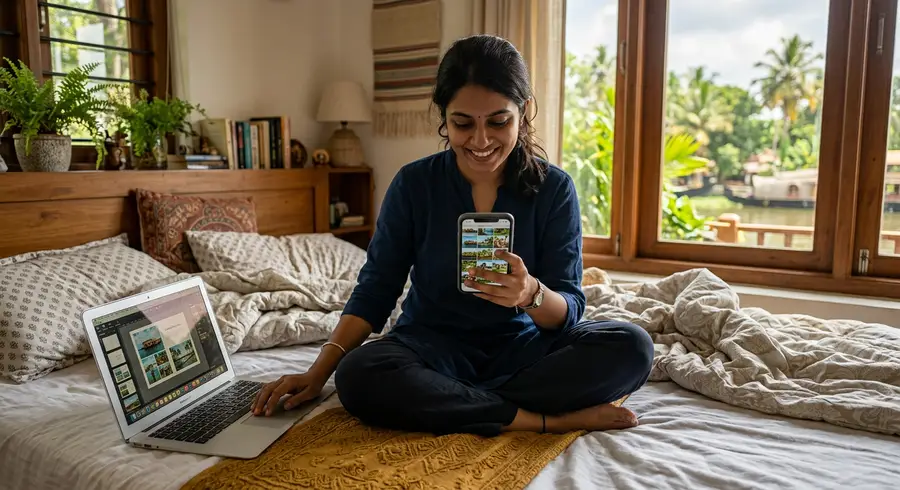
Choosing the Right Size and Format for a Travel Photo Book
For wedding photo books, large formats win - you want that lay-flat, wall-sized spread of the baraat procession. Travel books are different. Smaller is almost always better.
Think of it like camera bags. A full-frame kit bag is right for a dedicated photoshoot. A sling bag that fits in the overhead locker is right for travel. The format has to suit the use case.
Here's how the sizes break down:
5x7 or 4x6: Great for solo trips or short getaways. Feels personal, like a journal. Fits in a drawer or bag pocket. Works for 30-50 photos. Budget print services in India offer this range starting around ₹299-₹599.
8x8 square: The sweet spot for most Indian travel books. Handles portrait photos without awkward cropping. Fits 60-80 photos comfortably. Square format works particularly well for smartphone photography because so many phone shots are composed square-ish by default.
8x10 or 10x8 landscape: Good for trips with lots of landscape photography - hill stations (Manali, Coorg), beach horizons (Goa, Kerala), or wide heritage shots (Hampi, Rajasthan forts). Less portable but excellent for panoramic photos.
Lay-flat binding matters if you have wide landscape shots you don't want split by a gutter at the center. For most travel books with mixed content, standard binding is fine and significantly cheaper. Save lay-flat for trips where panoramic images are central to the experience.
Cover material: hardcover wins for durability, full stop. A softcover travel book that gets tossed in a backpack will show corner wear within a year. The cost difference in India is usually ₹200-₹500 for the upgrade - worth it every time.
How to Make a Travel Photo Book - Step by Step
-
Separate your photos by trip
Create a labelled folder or album for each trip you want to include. If you're making a multi-trip book, decide how many journeys it will cover and gather those photos into separate folders now. Clear folder names save significant confusion later — "Goa-Dec2024" beats "New folder (3)." -
Cull to your target count
Apply the wall test to each folder. Target 60-100 photos per trip for a full book, 40-60 for a smaller volume. Delete blurry, redundant, or context-less shots. If you can't decide between two similar shots, keep the one with better light and delete the other. -
Sequence photos into a story arc
Arrange surviving photos into narrative order: arrival, context, activities, food, people, close. You don't need to follow exact chronology - move a great sunset photo to the end of that day's sequence even if it was technically shot before dinner. Story logic beats timestamp logic. -
Choose your book size and binding
Pick size based on content: 8x8 square for mixed or portrait-heavy trips, 8x10 landscape for panorama-heavy destinations, 5x7 for short getaways. Choose hardcover. Opt for lay-flat binding only if you have wide panoramic shots you want to display without a center gutter. -
Choose a print service and design your layouts
Upload your selected photos. Design layouts that match the trip's mood - give high-drama shots full-page treatment, use smaller grids for activity montages, leave some pages with one strong photo and white space. Resist the urge to cram photos because you feel guilty about having "culled too many." -
Review proofs carefully
Most services offer a digital preview before ordering. Check for crops - portrait photos especially can get clipped at edges if the service auto-fits to a landscape template. Check that any text captions are readable at print size. Zoom into background details on hero shots. -
Order and specify archival printing where available
When ordering, look for archival pigment or silver halide printing options. These cost more but resist fading for decades rather than years. Standard photo paper on budget services can yellow or fade visibly within 5-10 years in a tropical climate. Once satisfied with the proof, place your order and allow 5-10 business days for delivery.
Why Print Quality Matters More for Travel Books Than Wedding Books
Wedding albums sit in a climate-controlled cupboard for most of their life. Travel photo books get handled constantly - pulled out to show guests, carried to family gatherings, occasionally wedged in a bag next to a water bottle.
That difference in use pattern is why print quality matters more for travel books, not less.
Think of it like hiking boots versus formal shoes. Both need to look good, but one needs to survive actual terrain. A travel photo book on cheap photo paper will show degradation within a few years: yellowing edges, faded highlights, pages that feel limp and stick together in humidity. A well-printed book on the same shelf looks fine for decades.
India's climate adds an extra layer to this problem. If you live in Mumbai, Chennai, Kerala, or anywhere along the coast, your home has baseline humidity that stresses printed paper year-round. Tropical trips - Goa, Andaman, Coorg in monsoon - mean the book itself might experience high humidity during travel. Even Rajasthan, dry as it is, has summer heat extremes that age cheap paper faster than lab conditions predict.
According to Wilhelm Imaging Research, the recognized authority on print longevity testing, standard consumer photo lab prints have display lives as short as 10-26 years under average home conditions. Archival pigment prints on quality coated media can last 100 years or more under the same conditions. That's not a minor gap - it's the difference between a photo book that makes it to your child's wedding and one that's an embarrassment at your next anniversary.
Waterproof photo prints use archival-grade pigment inks and coated media that resist moisture and UV degradation specifically - which is why they're worth considering for travel books that will face more environmental stress than a ceremonial album ever does.
For comparison, a wedding photo book typically gets one or two major viewings per year. Your Goa or Spiti book might come out a dozen times in the same period when you're showing friends or revisiting the trip yourself. The print quality that seems fine for a rarely-handled wedding album simply degrades faster under that kind of use pattern.
And this is where the spending calculus shifts. Budget ₹500 now and replace in 8 years, or spend ₹3,000-₹5,000 once on archival printing and have it last 30+ years. Most people who think about it this way spend the extra money without hesitation.
According to a Photobook Industry Association survey, travelers who invest in premium photo books report returning to them an average of 8-10 times per year - far more than any digital album or cloud gallery.
If you're also documenting a different milestone - the first year with a new child, for instance - the same archival paper logic applies to a baby photo book, where the book gets handled even more frequently than a travel volume over the long term.
Frequently Asked Questions
How much does a travel photo book cost in India?
Budget travel photo books in India start around ₹299-₹599 for small soft-cover formats with 20-30 pages. Mid-range hardcover options with 60-80 pages typically run ₹1,500-₹3,500. Premium archival printing on larger formats costs ₹5,000-₹12,000. The price gap reflects paper quality and print longevity - not just page count or size.
How many photos should I include in a travel photo book?
For a single trip, 60-100 photos is the right range for a full book. More than 120 usually means duplicates survived the cull. Fewer than 40 tends to feel thin and rushed. For short weekend trips or micro-holidays, 30-50 photos in a 5x7 format works well - quality over quantity every time.
Can I make a travel photo book from phone photos?
Yes - modern smartphones at 12-50 megapixels produce files large enough to print at 8x10 without quality loss. The main risk is photos taken in low light or at 5x digital zoom, which can look grainy when enlarged. Check photos at 100% zoom before including them. Blurry on a phone screen becomes very blurry at print size.
What's the best size for a travel photo book in India?
8x8 square is the most versatile size for Indian travelers. It accommodates portrait-mode phone photography well, fits on most shelves, and is easy to carry. For trips with strong landscape photography - hill stations, forts, beaches - 8x10 landscape gives panoramic images more room to breathe without cropping.
How do I organise photos from multiple trips in one book?
Use a chapter-per-trip structure with a clear visual break between journeys. A solid-colour divider page with the destination name and dates is the cleanest approach. Within each trip, organise by story arc - arrival, activities, food, close - rather than strict date order. Most print design tools support this chapter structure natively.
Travel photo books are one of the few physical objects that genuinely improve with time. A book from your Spiti trip in 2022, pulled out in 2040, holds something no hard drive or cloud album can replicate - but only if the prints last. The prints that last are the ones made on waterproof, fadeproof media with archival pigment inks, built to resist the humidity, the handling, and the decades between the trip and the memory. That's the standard worth holding to.