

Most photo printing services in India look identical on the surface. A website, a price list, a few format options, and delivery to your door. The real differences are in what you can't see before you order: the ink chemistry, the paper weight, the colour calibration process, and whether the prints you receive in two years still look like the ones you unboxed. Part of the photo print buying guide, this page gives you a framework for evaluating any service before you commit - so you're not discovering the quality difference six months later.
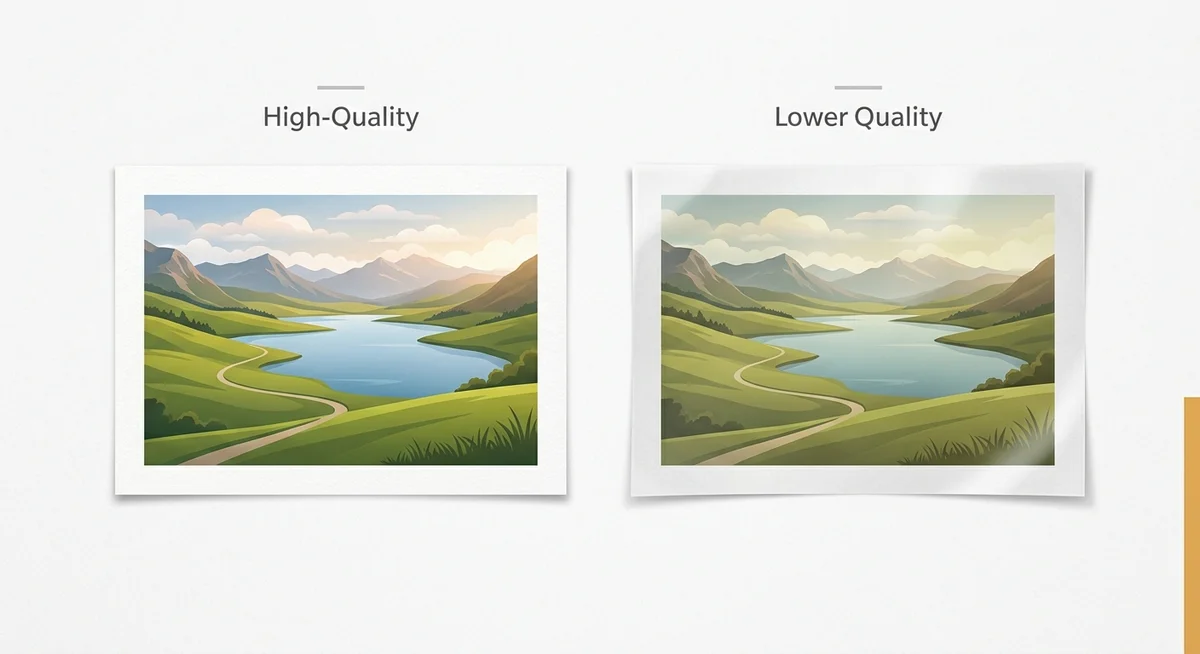
The Three Non-Negotiables
1. Ink Type: Pigment vs Dye
This is the single most important technical specification in photo printing. The type of ink used determines colour accuracy, longevity, and resistance to environmental degradation.
Dye-based inks dissolve into the paper fibre. They produce vivid initial colours at low cost. Within 1-3 years under normal conditions - and faster under UV exposure or humidity - the dyes break down and colours shift. Reds go orange, blues fade, skin tones go yellow. In India's climate, this degradation is accelerated by heat and humidity year-round.
Pigment-based inks sit on the paper surface as stable solid particles. They don't dissolve, don't bleed, and don't break down under UV or moisture. According to Wilhelm Imaging Research, the leading authority on print longevity, pigment-based prints maintain colour accuracy for 50-100+ years under normal display conditions.
How to check: Look for explicit mention of "pigment inks" or "pigment-based printing" on the service's website. If you see only "high quality inks" or "professional inks" without specifying pigment, call them or email and ask directly. Any service using pigment inks will say so proudly. Services using dye-based inks typically avoid the subject.
2. Waterproof and Fadeproof Guarantee
A service that uses pigment inks will guarantee their prints against water and fading because the chemistry supports that guarantee. A service using dye-based inks cannot make this guarantee honestly.
Look for explicit language: "waterproof prints", "fadeproof", "fade-resistant", "water-resistant coating". If the service guarantees print longevity in years, ask how many - vague claims like "long-lasting" are meaningless. According to Library of Congress preservation data, the difference between pigment and dye prints is not a marginal improvement - it's an order-of-magnitude difference in lifespan. Only services using archival-grade materials can make credible longevity guarantees.
3. Format Range
A service offering only 4R and 5R is using basic consumer equipment. A service offering polaroids, squares, photo strips, custom sizes, timeless prints, and specialty formats like keychains has invested in professional production capability. Format range is a proxy for the service's overall investment in quality and equipment.
For a full overview of available formats, the photo print collections page covers every format with use cases.
Secondary Evaluation Factors
Once you've confirmed the three non-negotiables, these factors differentiate between services that are all using quality materials:
Paper Weight and Coating
Good photo prints use paper in the 250-300 gsm range with an appropriate coating (gloss, matte, or satin). Thin paper (below 200 gsm) makes prints feel cheap and contributes to warping in humid conditions. The coating protects against surface scratches, fingerprints, and moisture penetration.
Ask: "What is the paper weight for your prints?" If they can't answer, or if the answer is below 200 gsm, the paper quality is a cost-cutting area. This matters less for temporary display but significantly for prints you'll handle, gift, or keep for years.
Colour Calibration
Colour accuracy is the gap between what you see on your screen and what comes out of the printer. Professional printing services use ICC colour profiles - standardised calibration data matched to their specific printer-paper-ink combination. This minimises the gap between digital and print colour.
Services without calibration use generic colour profiles or none at all. The result is prints with colour casts (a systematic lean toward green, yellow, or blue) that aren't visible until you compare the print to the original photo.
Upload and Ordering Experience
The ordering interface tells you something about how the service thinks about customers. A well-designed ordering flow includes: clear size options with visual previews, crop preview before confirming (so you can see exactly what gets cut), resolution check warnings if your image is too low quality for the chosen size, and transparent pricing without surprise fees at checkout.
For a step-by-step walkthrough of what a good ordering process looks like, the guide to ordering photo prints online covers each stage.
Packaging and Shipping
Photos are fragile. They bend under pressure, scratch without protection, and absorb moisture if packaging fails. Look for: rigid mailers (not soft envelopes), individual sleeves or protective tissue between prints, waterproof outer packaging. During India's monsoon season (June-September), packaging quality becomes especially important. A service that ships in flimsy packaging is optimising for cost at the expense of the product arriving undamaged.
Red Flags to Watch For
- No mention of ink type anywhere on the site. This is the strongest signal that dye-based inks are in use. Good services lead with "pigment inks" because it's a genuine differentiator.
- No waterproof or fadeproof guarantee. Without archival-grade inks and coating, this guarantee can't be made. Absence of the claim = absence of the quality.
- Only standard sizes (4R/5R). Indicates basic equipment and limited investment in production quality.
- Very low prices relative to competitors. Photo printing has fixed material costs. If a service is significantly cheaper than others, something in the material chain is being cut - usually ink quality and paper weight.
- No crop preview in the ordering flow. Tells you the service hasn't invested in the ordering experience, which usually correlates with other shortcuts.
- Vague delivery timelines. "Ships soon" or "estimated delivery varies" without specific windows. Services with reliable production have reliable timelines.
Questions to Ask Before Ordering
If a service's website doesn't answer these directly, email or chat before placing an order:
- "Do you use pigment-based or dye-based inks?"
- "Are your prints waterproof and fadeproof?"
- "What paper weight do you use for [format]?"
- "What is your estimated longevity for prints stored in normal indoor conditions?"
A service confident in their quality will answer all four quickly and specifically. A service that deflects or gives vague answers is telling you something important.
Frequently Asked Questions
How do I find the best photo printing service in India?
Check three things: ink type (must be pigment-based), waterproof/fadeproof guarantee, and format variety. Call or email if the website doesn't specify. Services using quality materials will answer directly. Also check packaging practices and ordering experience - both signal overall investment in quality.
What is the difference between pigment and dye photo prints?
Dye-based prints are cheaper and fade within 1-3 years. Pigment-based prints cost more but last 50-100+ years. Dye inks dissolve into paper and break down under UV and humidity. Pigment inks sit on the surface as stable particles and resist environmental degradation. For any print you want to keep, pigment is the only viable option.
Are local photo printing studios better than online services?
Not necessarily. Most local studios use consumer-grade dye-based printers. Some use professional equipment, but rarely with pigment inks or archival paper. Online services that specialise in quality photo printing typically use better equipment and materials than a general-purpose local studio. The key is the ink type and materials, not the location.
How can I tell if a photo print is good quality before ordering?
Ask about ink type (pigment vs dye), request a sample if available, and check for explicit waterproof/fadeproof guarantees. Read reviews specifically mentioning longevity - not just "looks great" but "still looks great after a year". Avoid services that use vague quality language without specifications.
Is cheaper photo printing worth it in India?
Only for temporary use. Budget printing uses dye-based inks on thin paper. If you're printing for an event backdrop, a temporary display, or anything that won't be kept, cheaper is fine. For photos you'll display on walls, gift to people, or keep for years - cheaper is not worth it. You'll reprint them, and the reprint will fade again.