

- A baby photo book preserving Indian milestones - namkaran, annaprashana, first birthday - becomes a document your child will look at for decades.
- First-year books need 80-100 pages; newborn-only books work well at 40-60 pages.
- Archival, fade-resistant paper matters more for baby books than any other photo product - children handle these books repeatedly as they grow up.
My mother found her baby photos last year. They were in a cardboard box, yellowed at the edges, two of them stuck together where moisture had gotten in decades ago. She peeled them apart carefully, but the damage was done - half of one photo came away with the other. The image of her first birthday was gone.
She told me about it while looking through my daughter's photos on my phone. "At least yours won't fade," she said. But I wasn't so sure. Phone storage fails. Hard drives crash. And phones get upgraded every two years, photos migrating each time, some lost in transit.
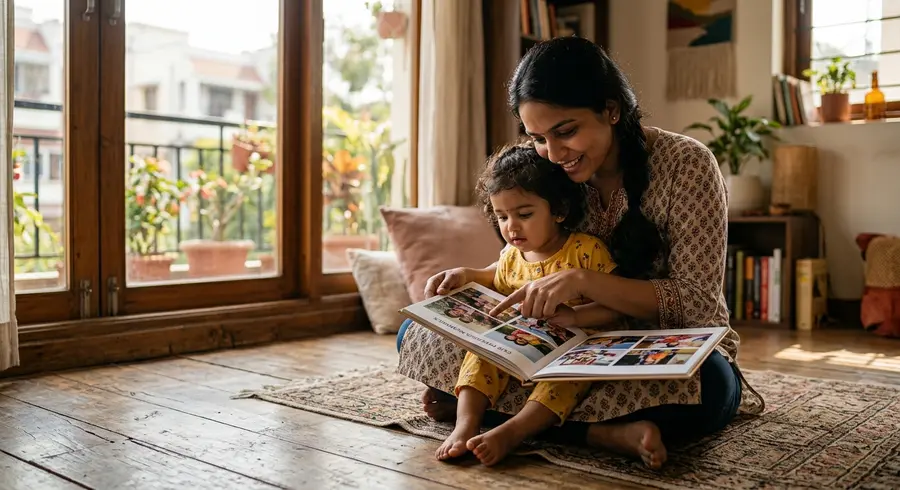
A baby photo book india parents order today is different from that cardboard box. When printed on archival paper with fade-resistant inks, it survives the same way hardcover books do - because it is a hardcover book. Your child picks it up at age 8, at 20, at 35. The photos look the same.
That's the reason this matters. Not the keepsake sentiment - that's obvious. The reason is longevity. A properly made baby photo book outlasts every digital storage option you have.
What to Include in a Baby Photo Book (Indian Milestone Checklist)
A baby photo book built around India's first-year milestones tells a story most photo albums never capture. Here's a 40-word answer for anyone searching this question: a complete baby photo book should include hospital homecoming, naming ceremony, first outdoor outing, annaprashana, ear piercing, first smile, first laugh, tummy time, first solid food, and first birthday - roughly 10-12 milestone moments across the year.
Voice search answer: Include the hospital homecoming, naming ceremony, annaprashana, first laugh, first solid food, and first birthday - each moment printed with its date and a short caption.
Here's what to actually photograph at each one - because the moment matters less than the angle:
- Hospital Homecoming - The first step through the front door. Capture the whole family in frame, not just the baby. The expressions of grandparents seeing the baby for the first time won't repeat.
- Namkaran (Naming Ceremony) - Get a close-up of the baby's face during the priest's chant, and a wide shot of the gathered family. The gold jewelry and new clothes are detail shots worth including separately.
- First Smile - Genuine smiles start around 6-8 weeks. Shoot in natural light with no flash. The baby's eyes need to be in focus - blur everything else.
- Tummy Time - This looks unremarkable on the day, but at age 10, your child will find it hilarious. Shoot from floor level, face-to-face with the baby.
- First Laugh - You won't know when it happens. Keep your phone in burst mode during playtime from month 3 onward. One frame will be perfect.
- Karna Vedha (Ear Piercing) - Mostly common for baby girls. The before-and-after sequence works well: baby before the ceremony, then wearing the gold earrings for the first time.
- Annaprashana (First Rice Feeding) - A full scene: the banana leaf, the silver bowl, the family gathered, and the baby's reaction to the first solid food. This ceremony deserves at least 3-4 frames in the book.
- First Bath at Home - Often done by the grandmother in traditional households. The water, the hands, the baby's face - this is documentary photography, not posed.
- First Outdoor Outing - Many families wait 40 days before taking the baby outside. That first outing - the baby's face in open air, the sunlight - tells a cultural story.
- Monthly Milestone Photos - A consistent backdrop or prop (same blanket, same stuffed animal) at months 1 through 11 creates a growth sequence that's genuinely striking when printed together on one spread.
- First Steps - Usually between 9-14 months. Shoot from low, at floor level. The slightly blurred motion of small feet is better than a perfectly sharp but static pose.
- First Birthday (Janmotsav) - The cake smash, the family, the child's face covered in frosting. Also get a quiet moment at the end of the day when the child is tired and surrounded by gifts - that one photograph always becomes the favorite.
I find the monthly milestone sequence underrated by most parents. Eleven images - one per month - printed as a grid on a single double-page spread shows a year of growth in a way no single photo can. When your child looks at it at age 15, they'll spend longer on that page than any other.
For parents using Memoriffy's photo book service, the layout tool lets you set up exactly this kind of sequence spread without any design skills.
How Many Pages Does a Baby Photo Book Need?
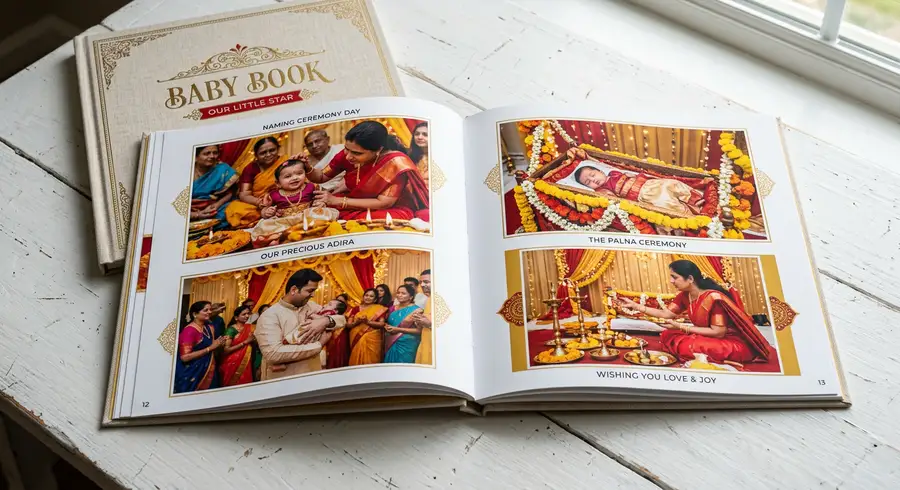
Page count depends on what you're documenting. For a first-year book covering all 12 months, 80-100 pages gives you enough room to let photos breathe without padding. For a newborn-only book covering the first 3-4 months, 40-60 pages works well.
A common mistake is trying to fit everything into 30-40 pages. Photos get crowded, captions get cut, and the book starts to feel like a summary instead of a story. Think of it like a documentary film vs. a trailer. The trailer has everything, but you don't feel anything. The documentary gives moments room to land.
A practical page structure for a first-year book:
- Pages 1-10: Hospital and homecoming
- Pages 11-25: Namkaran, first weeks, early milestones
- Pages 26-50: Months 2-6, including annaprashana
- Pages 51-75: Months 7-11, first steps, karna vedha
- Pages 76-100: First birthday, family portrait spread, closing page
According to Parents magazine's guide to baby memory books, the most common regret among parents is not printing enough photos - not printing too many. Start with more pages and trim down; it's harder to add pages after the fact.
Tips for Making a Baby Photo Book That Lasts
Paper quality is where most generic photo books fail. Standard photo paper - the kind used for holiday cards and school photos - has a rated lifespan of 25-40 years under ideal storage conditions. But a baby photo book isn't stored. It's handled.
Your child picks it up. Their friends pick it up. It gets left in sunlight on a coffee table. It goes on a shelf in a room that gets humid in July. Standard photo paper yellows and fades under these conditions far faster than the rated lifespan suggests.
Archival-grade paper is rated at 100+ years. The difference is acid-free substrate and pigment-based inks rather than dye-based inks. Wilhelm Imaging Research, the photographic industry's standard testing lab, documents the fade rates of different print technologies under real-world conditions. Their data shows pigment-based prints lose less than 10% density over 100 years under typical indoor light. Dye-based prints - which is what most consumer photo books use - can fade noticeably within 15-25 years.
For a baby photo book, that gap matters. Your child is 0 years old now. You want them to open this book at 30 and see the same colors you see today.
The other factor is binding. Layflat binding - where pages open completely flat without a gutter crease in the middle - matters more for spreads than for single-page photos. If you're doing the monthly milestone grid or an annaprashana spread, you need the pages to lie flat. Standard sewn binding creates a shadow crease down the center that bisects the image.
Memoriffy prints use waterproof and fade-resistant paper - the same archival standard used in professional gallery printing. For a product your family will handle for 30 years, that's the right starting point.
One thing parents rarely think about: include a few text pages. A printed page with your child's birth weight, the time they were born, what you named them and why, your first reaction when you held them - that text will mean more at age 30 than any photograph. Photos show what happened. Text tells what it felt like.
The same archival principles apply across photo book types - whether you're documenting a year of milestones, a wedding, or a journey. For families with travel photos worth preserving alongside the baby's first year, our guide to making a travel photo book covers curation and durability for trips you'll show the child years later.
Frequently Asked Questions
What size should a baby photo book be?
For a first-year book, 12x12 inches (square) or 12x8 inches (landscape) gives you enough room for multi-photo spreads. Smaller sizes - 8x8 or 6x8 - work for newborn-only books or gift copies for grandparents. The main book your family keeps should be large format; small photo books look thin and feel like tourist souvenirs rather than heirlooms.
How do I organize photos for a baby photo book in India?
Sort by milestone rather than by date. Group hospital photos together, namkaran together, annaprashana together - then fill the gaps between ceremonies with candid everyday moments. This gives the book a narrative shape. A pure chronological approach works but tends to create uneven sections where some months are over-photographed and others have nothing.
Is a baby photo book different from a baby memory book?
A baby memory book is typically a pre-printed journal with prompts - spaces to write down the first word, the first tooth, height at 6 months. A baby photo book is custom-designed with your own photos. Many parents want both: the memory book as a companion journal, the photo book as the visual archive. They serve different purposes and don't replace each other.
When should I order a baby photo book - during the first year or after?
After. Order at 12-14 months when the first year is complete. Ordering in stages - a newborn book at 3 months, then another at 6 months - fragments the story. The full year, beginning to first birthday, reads as a complete chapter. Most parents who order early end up wanting a second book anyway once they see the first birthday photos.
Ready to build your baby's first-year book?
Memoriffy prints baby photo books on archival, fade-resistant paper with layflat binding - built to last longer than any hard drive. Explore the photo book collection or start designing yours today.