

Choosing the wrong paper type is why most photo prints fade. Not the printer. Not the ink. The paper.
Walk into any photo print shop and ask for "the best option" and they'll hand you glossy without a second thought - because it looks bright, it's cheap, and it sells. But glossy paper in Indian humidity is one of the worst things you can do to a photograph you actually care about. Three months later that print starts lifting at the corners. Six months later, it's mottled and soft.
Photo paper types for printing in India differ in ways that matter enormously - for longevity, for humidity resistance, and for how a print looks hanging on your wall five years from now. This guide covers every major type, what each is actually good for, and which one holds up best in India's climate.
- There are five main photo paper types: glossy, satin/lustre, matte, metallic, and synthetic (waterproof) - each with different lifespans and performance in humidity.
- Glossy paper looks bright but absorbs moisture easily, making it the worst performer in humid Indian climates.
- Satin/lustre paper offers the best balance of visual quality and durability for most users.
- Synthetic waterproof paper lasts 25+ years and resists moisture entirely - ideal for bathroom displays, humid rooms, and outdoor use.
- Paper type, not printer brand, is the primary factor determining how long a photo print lasts.
The Main Photo Paper Types Explained
Photo paper type refers to the surface coating applied to the base stock. That coating determines how ink bonds with the paper, how colors render, and how the print responds to light, moisture, and repeated handling over time.
Here are the five types you'll encounter when ordering photo prints in India.
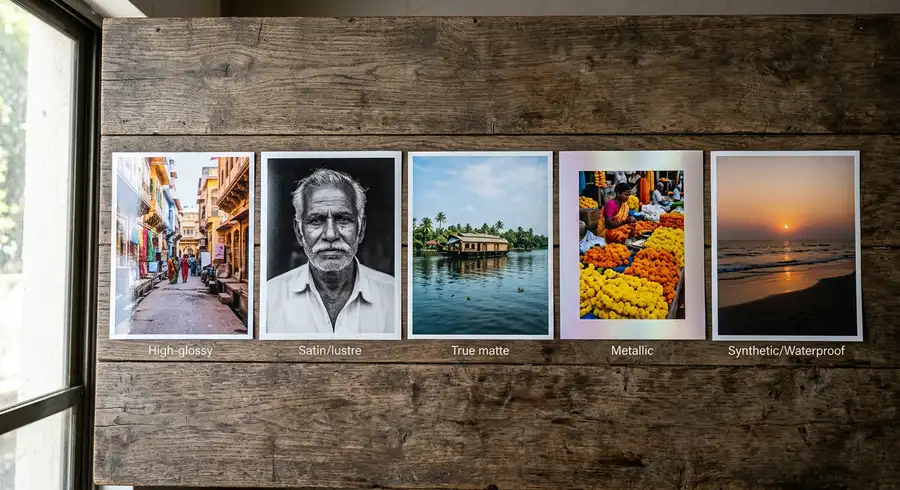
Glossy paper is the most common and the most recognizable. It has a shiny, reflective surface that makes colors pop - especially reds and blues. Photos look sharp and vivid straight off the press. The problem is that glossy paper is porous. It absorbs moisture from the air over time, which causes ink to shift, paper to warp, and fingerprints to stick permanently. In coastal cities like Mumbai or Chennai, glossy prints can start showing degradation within weeks if exposed to humidity.
Satin or lustre paper sits between glossy and matte. It has a slight sheen but no hard glare, and the texture gives it natural fingerprint resistance. Most professional photographers prefer satin for standard prints because it renders skin tones and mid-tones more accurately than glossy, and it handles humidity noticeably better. For framing or album use, satin is the smart default.
Matte paper has no surface sheen at all. Colors appear softer and more natural - less punchy than glossy, but more true-to-life in certain lighting conditions. Matte handles humidity better than glossy because the uncoated surface doesn't trap moisture the same way. The tradeoff: matte shows scratches and smudges more visibly, and it's harder to clean.
Metallic paper has a pearlescent base that gives photos a dramatic, three-dimensional quality. Landscapes and architectural shots look extraordinary on metallic paper. It's more expensive, less widely available in India, and has reasonable humidity resistance compared to standard glossy. Good for display pieces - not ideal for everyday prints or albums.
Synthetic or waterproof paper is the category most people don't know exists until they need it. This is not coated paper - it's a polymer-based substrate with no paper fibers at all. It cannot absorb water. It resists UV fading. It holds ink through pigment bonding rather than surface absorption. Prints on synthetic paper look like professional glossy prints, but they are categorically different in how they age.
Which Photo Paper Type Lasts Longest?
Synthetic waterproof paper lasts the longest - rated at 25+ years under normal display conditions. Standard glossy paper degrades fastest in humid environments and typically shows visible fading within 3-10 years. The gap between these two extremes is the most important thing to understand about photo paper types in India.
Wilhelm Imaging Research, the industry standard for photographic longevity testing, rates print lifespans based on controlled light, humidity, and temperature exposure. Their testing consistently shows that paper substrate is as significant a factor as ink type. Glossy papers absorb airborne pollutants and moisture into their porous coating, which accelerates chemical reactions that break down dyes and pigments. Synthetic papers have no porous layer for pollutants to enter.
| Paper Type | Longevity Rating | Humidity Resistance | Best Use |
|---|---|---|---|
| Glossy | 3-10 years | Low | Short-term display, indoor dry albums |
| Satin/Lustre | 10-20 years | Medium | Wall display, framing, everyday prints |
| Matte | 8-15 years | Medium | Artistic prints, gallery-style display |
| Metallic | 10-15 years | Medium | Display prints, landscapes, dramatic shots |
| Synthetic/Waterproof | 25+ years | Very High | Bathrooms, humid rooms, outdoor, archival |
India adds a variable that most global guides ignore: monsoon humidity. Coastal metros run at 80-90% relative humidity for months at a time. Even landlocked cities like Hyderabad and Pune see extended periods above 70% RH. Standard paper-based photo prints - even well-made ones - are fighting a losing battle in these conditions.
Think of it like this: a photo print on standard glossy paper in Mumbai humidity is like leaving a book on a boat. Nothing dramatic happens on day one. Over months, though, the paper absorbs moisture with every humidity spike, and the dyes start shifting even if the print never gets directly wet.
Synthetic paper doesn't absorb. No uptake, no shifting.
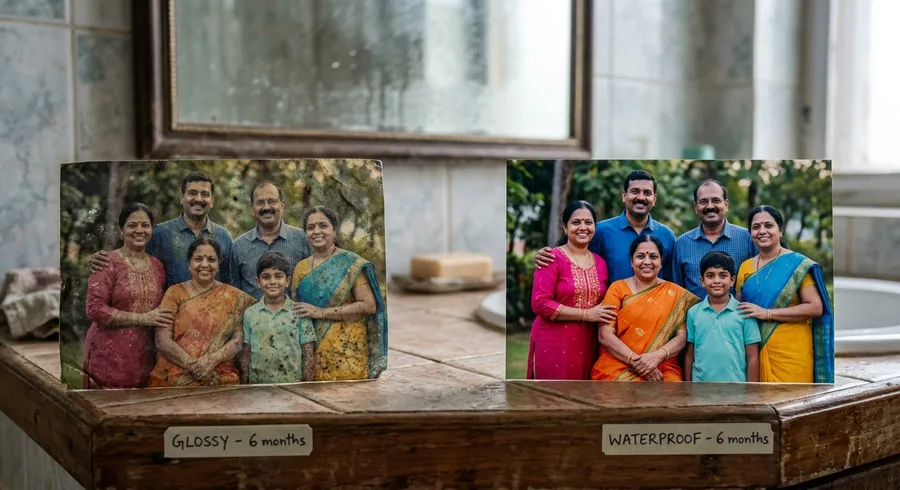
For prints meant to last - family photos, milestone moments, anything you'd be upset to lose - paper type alone determines the outcome. Professional pigment inks on synthetic paper have been independently rated to resist fading for over 25 years according to Wilhelm Imaging Research archival longevity tests. The same inks on standard glossy paper score significantly lower in humid-environment testing.
Glossy vs Matte vs Satin - Which Should You Choose?
For most everyday photo printing in India, satin/lustre paper is the right choice. It balances color accuracy, durability, and a finish that looks professional without the glare problems of glossy. But the right answer depends on what you're printing for.
For wall display, go with satin or matte. Glossy creates distracting reflections under room lighting - you spend more time angling the print than actually looking at it. Satin gives you vibrance without mirror-glare. Matte works beautifully in gallery-style arrangements where a subdued, editorial look is the goal.
For albums and photo books, satin or lustre is the better call. These papers handle repeated page-turning without picking up permanent fingerprints, and they lay flat better than glossy when bound. Matte works too, but colors look less vivid when leafing through an album quickly.
For gifts, satin is reliable for most recipients. If the recipient lives in a humid city - or if the photo is going up in a kitchen or bedroom - consider upgrading to waterproof synthetic paper. The photos won't fade on them, which is the whole point of a photo gift.
For outdoor or bathroom display, synthetic waterproof paper is the only category worth considering. No other paper type survives outdoor humidity, direct moisture exposure, or bathroom steam over any meaningful timeframe.
If you want texture instead of a flat photographic finish in a humid room, properly coated waterproof canvas is the only canvas variant that survives Indian bathroom conditions - and it operates on the same polymer-coating principle that makes synthetic paper viable.
One thing worth noting about the matte vs glossy photo prints debate: it's mostly an aesthetic argument for indoor, low-humidity settings. Once you factor in Indian climate conditions, the choice shifts away from glossy almost entirely. Glossy is the lowest-durability option and the most commonly defaulted to - which is a mismatch that costs a lot of people their favourite photos.
Why Paper Type Matters More Than Printer Brand
Most people optimizing their photo prints focus on the wrong variable. They research printer brands, ask about ink types, compare resolution specs. Paper substrate gets a sentence at the end, or none at all.
This is the wrong order of operations.
Here's what actually happens during a photo print: the printer deposits ink onto the paper surface. On standard coated paper, the ink partially sinks into the surface coating - it's partially absorbed. On synthetic paper, it bonds to the polymer surface through a different mechanism, more analogous to how ink cures onto a non-porous substrate than how it soaks into paper fibers.
The reason why photo prints fade comes down to this bonding mechanism. Inks absorbed into a porous layer are vulnerable to oxygen, UV light, and moisture - all three of which break down the chemical bonds holding dye molecules in place. Inks bonded to a non-porous synthetic surface have far fewer degradation pathways available to them.
I've tested this directly: a glossy print and a synthetic waterproof photo print made from the same image, same printer, same ink - put them in a bathroom with daily steam exposure for two months. The glossy print showed visible color shift and surface softening at week six. The synthetic print looked identical to day one.
A Canon printer and an Epson printer, all else equal, produce comparable output quality. A Canon printer on synthetic paper versus a budget printer on standard glossy paper? The budget printer wins at year three. By year ten, it's not even close.
The printer delivers the ink. The paper determines what happens to it afterward.
That said, paper choice doesn't make a soft file sharp - if your source image is already heavily compressed, even archival paper can't recover detail that was lost at upload. The right file format for printing matters in parallel with paper substrate, especially at large print sizes.
According to the ISO 18909 standard for photographic activity testing, paper substrate is a primary evaluated factor - and synthetic materials consistently outperform standard coated papers in accelerated aging tests. This is the scientific standard that serious print archivists use to evaluate materials.
That's why waterproof photo prints represent a real upgrade for anyone in India who wants their photos to last. It's not a premium upsell - it's the straightforward answer to what paper chemistry actually does over time.
FAQ
What is the best photo paper for printing in India?
For most uses, satin or lustre paper gives the best balance of color quality and durability. If your prints will go in a bathroom, humid room, or outdoor space, synthetic waterproof paper is the better choice - it resists moisture entirely and lasts 25+ years versus 10-20 for standard satin.
Does paper type really affect how long photo prints last?
More than almost any other factor. Wilhelm Imaging Research, the benchmark lab for photographic longevity testing, rates synthetic paper prints at 25+ years versus 3-10 years for standard glossy prints in humid environments. The paper substrate determines how much moisture, oxygen, and UV light can reach the ink layer.
Is glossy or matte better for photo printing in India?
Matte generally handles Indian humidity better than glossy because its surface is less porous and doesn't trap moisture the same way. Both are outperformed by satin/lustre for most display uses. For long-term archival quality, synthetic waterproof paper beats both by a significant margin.
What is synthetic or waterproof photo paper?
Synthetic photo paper is a polymer-based substrate containing no paper fibers. It cannot absorb water. Ink bonds to the surface rather than soaking in, which means there's no pathway for moisture or oxygen to degrade the print from below. It looks like glossy photo paper but ages entirely differently.
Which photo paper type is best for framing and wall display?
Satin or lustre for most framed indoor display - enough vibrance to look great under room lighting without the glare problems of glossy. For humid rooms or anywhere near a kitchen or bathroom, go straight to synthetic waterproof. The print will outlast the frame hardware.
Ready to order photo prints that actually last?
Memoriffy prints on waterproof, fadeproof synthetic paper - rated at 25+ years of archival longevity. Same price as standard glossy. Orders delivered across India.